What the Open-Jar Symbol on Your Makeup Actually Means
The little jar with '12M' on it tells you more than you think — and its absence tells you something too. What the law actually requires, in the EU and the US.
GlowSteal Editor
The small open-jar icon with a number and an M is the period after opening. 12M means the manufacturer considers the product fit for use for twelve months once you've opened it.
That much is widely known. The genuinely useful part is what the symbol's presence or absence tells you — because under EU law it is not optional decoration, and the rule behind it is the opposite of what most people assume.
The 30-month rule
Under the EU Cosmetics Regulation, which product gets which marking depends on how long it lasts unopened.
Article 19 of Regulation (EC) No 1223/2009 requires a minimum date of durability — the date until which the product, stored properly, "will continue to fulfil its initial function". That date is shown after the hourglass symbol or the words "best used before the end of".
Then comes the part that surprises people:
For products with a minimum durability of more than 30 months, the label must instead indicate "the period of time after opening for which the product is safe and can be used without any harm to the consumer" — shown as the open-jar symbol followed by the period in months or years.
So the logic runs backwards from the usual assumption:
| What you see | What it tells you |
|---|---|
Open-jar symbol (e.g. 12M) | The product lasts more than 30 months unopened. It is stable enough that the clock only starts when you open it. |
| A best-before date (hourglass, or "best used before the end of") | The product lasts 30 months or less unopened. The clock is already running. |
A PAO symbol is not a sign that a product expires quickly. It is a sign that it lasts a long time on the shelf — long enough that a fixed date would be meaningless. The products with a printed date are the shorter-lived ones.
The regulation also allows for the case where the concept simply doesn't apply — single-use products, for instance.
If you're shopping in the US, you may see neither
This is where a lot of confusion comes from, because much of the beauty content online blends the two markets.
US law does not require an expiry date or a period-after-opening symbol on cosmetics at all. The FDA states plainly that there are no regulations or requirements under current US law that require cosmetic manufacturers to print expiration dates on cosmetic labels.
Manufacturers remain responsible for determining shelf life as part of substantiating that the product is safe — but that obligation does not translate into a marking you can read in the shop.
So a US-market product carrying no date information is not necessarily cutting corners. It may simply not be required to tell you. Many brands selling into both markets print the symbol anyway, which is why you'll often see it on US shelves regardless.
The PAO period is the manufacturer's assessment of how long the product remains fit for use under normal conditions. It is not a guarantee, and it does not account for how you actually store and handle a product.
A mascara wand returned to its tube after every use, a jar product dipped into with fingers, or anything left in a hot bathroom or a car will not track the number on the label. Treat it as a planning figure, not a countdown.
Reading the rest of the packaging
While you're looking, the same regulation puts several other things on the label. The ones worth recognising:
The rest of what you'll find on the pack:
| Symbol | What it is | What it actually tells you |
|---|---|---|
Open jar with a number and M | Period after opening | Durability exceeds 30 months unopened. The clock starts when you open it. |
| Hourglass, or "best used before the end of" | Minimum date of durability | Durability is 30 months or less. The clock is already running. |
| Hand pointing at an open book | "See enclosed information" | Mandatory information didn't fit on the pack and has moved to a leaflet or the inside of the carton — usually warnings or the full ingredient list. Routine on small items like lip products. |
| Chasing-arrows triangle with a number | Resin identification | Which plastic the pack is made of. Nothing to do with product safety or shelf life. |
e next to the quantity | Estimated sign | A packaging-fill convention about how the contents were measured. Says nothing about the formula. |
The one people most often misread is the pointing-hand symbol. It looks like a warning and is not one.
If you want to actually use the PAO number, write the opening date on the packaging in marker the day you open it. The symbol tells you the duration; it cannot tell you when your clock started, and almost nobody remembers three months later.
What we could not establish
- Whether a product is unsafe past its PAO period. The regulation frames the period as how long the product remains safe and usable, not as a hard cliff after which harm begins. We have not found sourcing that quantifies risk after the period elapses, and we're not going to imply one.
- How much your storage shifts the real figure. Heat, humidity and contamination clearly matter. Putting numbers on that is beyond what we can source.
- Eye products specifically. You'll see confident advice to discard mascara every three months. That interval is widely repeated but we have not traced it to an authoritative source, so we're not repeating it as fact here. If you have had an eye infection, discard the product — that advice is uncontroversial.
Sources consulted, retrieved 28 July 2026:
- Regulation (EC) No 1223/2009, Article 19 — Labelling. Quoted for the minimum-durability and period-after-opening requirements and the 30-month threshold. Re-checked 28 July 2026 against the EU original text served by the EU Publications Office (
publications.europa.eu/resource/celex/32009R1223), because legislation.gov.uk hosts UK-assimilated law rather than the live EU text and the two can diverge. Article 19(1)(c) is word-for-word identical in both: "Indication of the date of minimum durability shall not be mandatory for cosmetic products with a minimum durability of more than 30 months. For such products, there shall be an indication of the period of time after opening for which the product is safe and can be used without any harm to the consumer." - Shelf Life and Expiration Dating of Cosmetics — US Food and Drug Administration. Cited for the absence of a US expiry-date requirement.
This article describes EU and US requirements as we read them on the date above; regulation changes, and this is general information rather than legal or medical advice. GlowSteal has not tested any product for this article.
Enjoyed this post?
Get more like it delivered every Tuesday.
You might also like
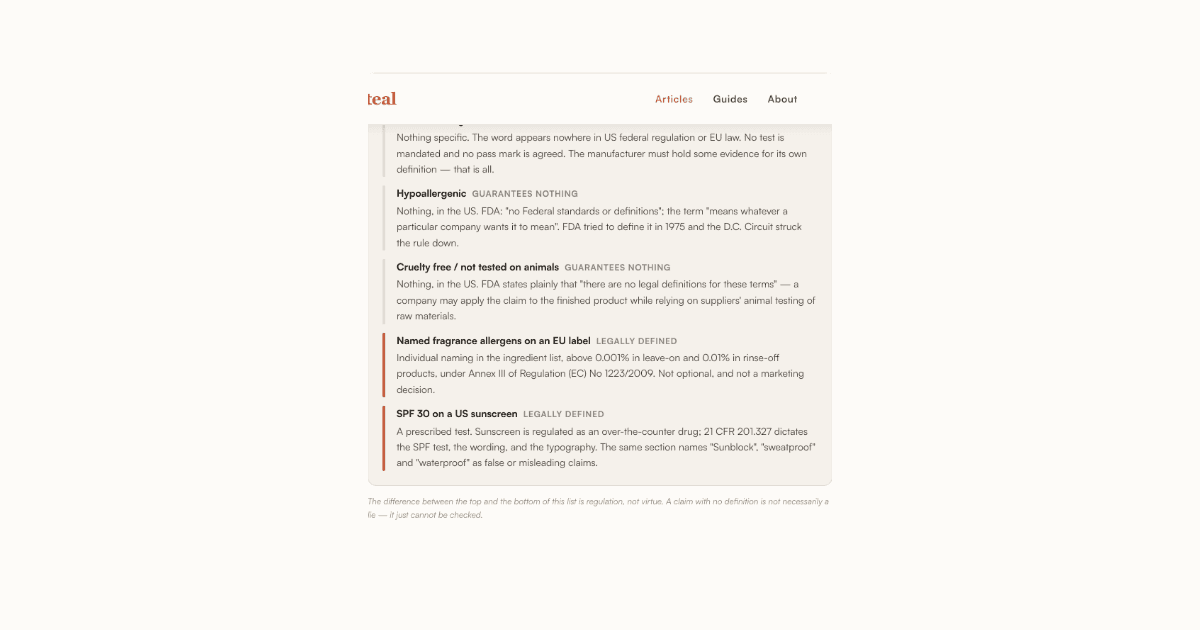
What 'Non-Comedogenic' Actually Guarantees
The word does not appear anywhere in US federal regulation, or in EU law. No test is required and there is no pass mark. Here is what the label is really telling you — and why dermatologists still say to look for it.
August 5, 2026
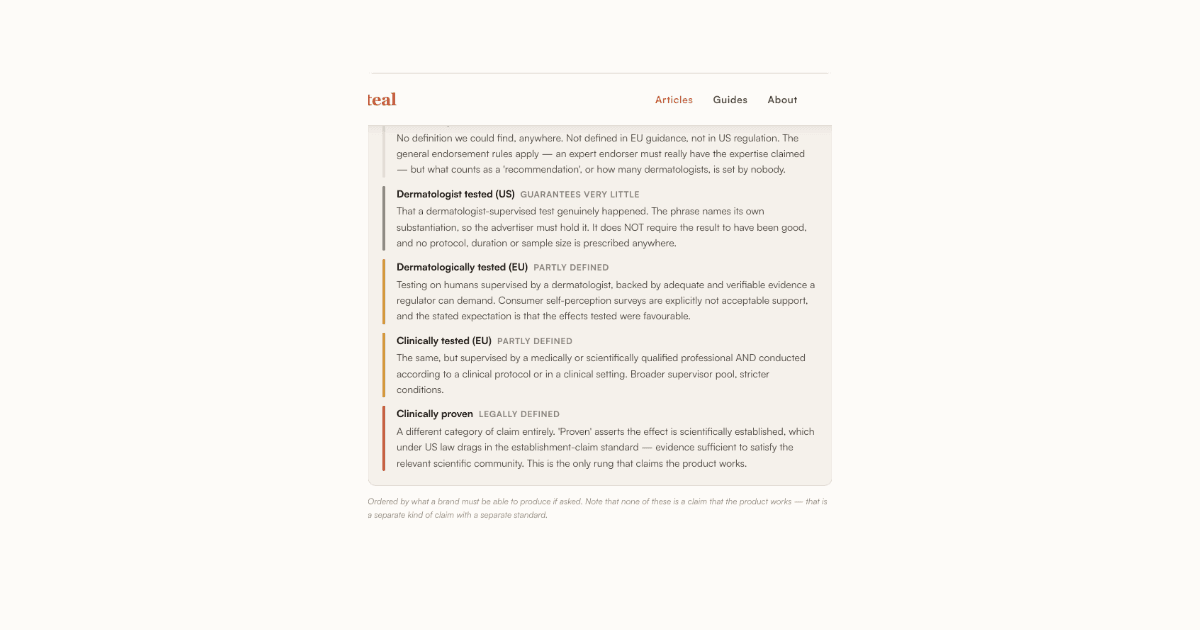
What 'Dermatologist Tested' Means on a Label
It is a claim about process, not result — and a European court ruled on exactly this phrase in 2002. What it obliges a brand to hold differs completely between the EU and the US.
August 4, 2026
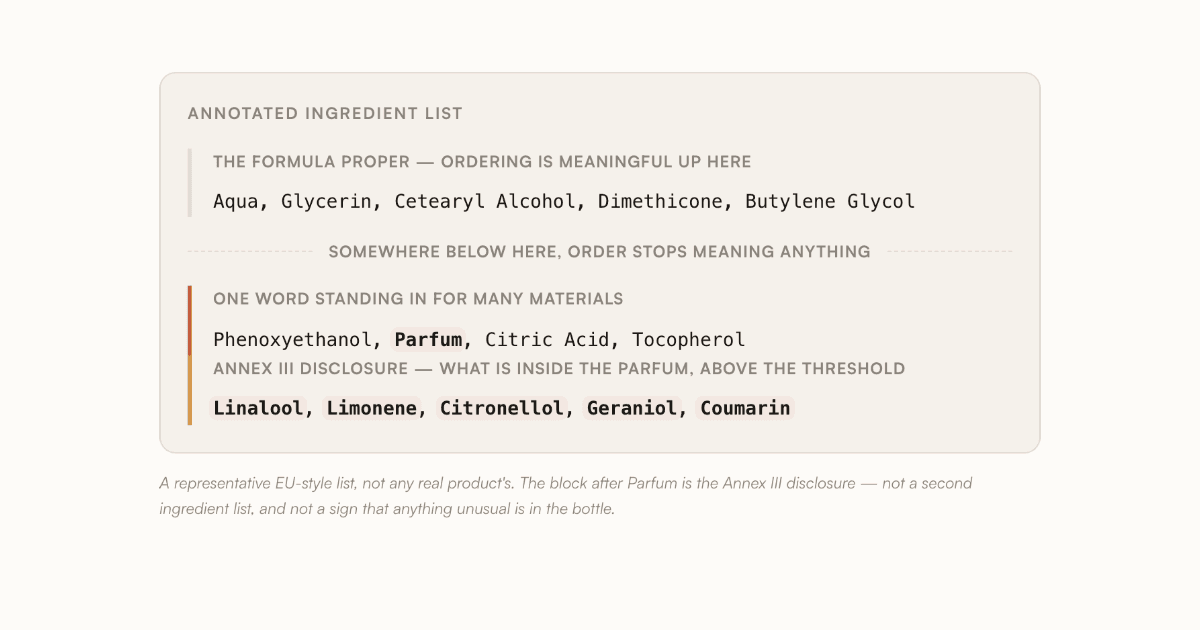
How to Spot Fragrance on an Ingredient List
The word to look for is 'Parfum' in the EU and 'Fragrance' in the US — and the chemical names sitting after it are not a separate ingredient list. Also: the '26 EU allergens' figure everyone quotes has been wrong since 2022.
August 3, 2026