What 'Dermatologist Tested' Means on a Label
It is a claim about process, not result — and a European court ruled on exactly this phrase in 2002. What it obliges a brand to hold differs completely between the EU and the US.
GlowSteal Editor
"Dermatologist tested" is a claim about process, not about result. It says a test happened, and that a particular kind of professional supervised it. It does not say the product works, and — in the US at least — it does not say the test went well.
That much you may already have read. What almost nobody mentions is that a court has actually decided what the phrase means, and that the answer is different on either side of the Atlantic for a reason worth understanding.
A court ruled on this, in 2002
The Court of Justice of the European Communities decided the question in Case C-99/01, Criminal proceedings against Gottfried Linhart and Hans Biffl, judgment of 24 October 2002. The products were an ordinary antibacterial liquid soap and an anti-dandruff hair product, both carrying "dermatologically tested" on the packaging. Austrian law at the time treated that as an unlawful reference to medical opinion unless the content and outcome of the opinion were given too.
At paragraph 32, the Court set out what an average consumer takes the phrase to mean:
"the statement 'dermatologically tested' which appears on the packaging of certain cosmetic products … cannot suggest to the average consumer who is reasonably well informed and reasonably observant and circumspect anything other than that the product underwent tests intended to study its effects on the skin and that, as a result, its placing on the market implies that the results of those tests were positive and that the product was well tolerated or at least harmless when applied to the skin."
Read what that is a claim about: tolerance and harmlessness. Not efficacy. The popular line — "it doesn't mean it works" — turns out to be right, but for a reason nobody states: the phrase was never understood as a performance claim in the first place.
The Court then concluded, at paragraph 35, that the phrase "could not mislead an average consumer".
Paragraph 35 opens "In those circumstances" — and the circumstances are the paragraphs immediately before it, which are the part that gets dropped every time this case is summarised.
The Court's reasoning rested on the fact that "the authenticity of those results is subject to monitoring by the national authorities", and that the person responsible for placing the product on the market was obliged to keep the underlying data, including "proof of the effect claimed for it", accessible to those authorities.
In other words: the phrase is not misleading because a mandatory evidence file sits behind it, not because the words are self-evidently informative. Take away the regulator's power to demand the file, and the reasoning does not transfer. Which brings us to the United States.
In the US, the phrase appears in no regulation at all
We full-text searched the official Government Publishing Office XML of 21 CFR Part 701 — the FDA's cosmetic labelling rules. The strings dermatologist and dermatological appear zero times. So does hypoallergenic. ("Descending order" appears five times, which confirms we were searching a real copy of the regulation and not an empty file.)
The only statutory hook is generic: 21 U.S.C. 362(a) makes a cosmetic misbranded "if its labeling is false or misleading in any particular." No number of dermatologists, no duration, no sample size, no protocol, no documentation standard.
You will see it said that US cosmetics regulation was overhauled in 2022. It was — the Modernization of Cosmetics Regulation Act added a real substantiation duty at 21 U.S.C. 364d.
But that duty is safety substantiation: evidence "sufficient to support a reasonable certainty that a cosmetic product is safe." It says nothing about substantiating advertised performance or testing claims. This particular gap was not closed.
But the phrase is not legally inert in the US either
This is where most write-ups stop, having concluded the term is meaningless. That overstates it, and the correction is more interesting than the debunk.
US advertising law distinguishes two kinds of claim. The D.C. Circuit restated the framework in POM Wonderful LLC v. FTC (2015):
"An efficacy claim suggests that a product successfully performs the advertised function or yields the advertised benefit, but includes no suggestion of scientific proof of the product's effectiveness … An establishment claim, by contrast, suggests that a product's effectiveness or superiority has been scientifically established."
And where a claim names its own evidence, the standard is specific: the "advertiser must possess the specific substantiation claimed."
"Dermatologist tested" names its own substantiation. A brand printing it must actually hold a dermatologist-supervised test. What it does not have to hold is a good outcome — the phrase claims that testing happened, not that anything passed.
The FTC's Endorsement Guides tighten this further where a professional is invoked. 16 CFR 255.2(a):
"the advertiser must possess and rely upon adequate substantiation, including, when appropriate, competent and reliable scientific evidence, to support express and implied claims made through endorsements in the same manner the advertiser would be required to do if it had made the representation directly"
Routing a claim through a professional does not lower the bar. And § 255.3(b) requires that an expert's evaluation have "included an examination or testing of the product at least as extensive as someone with the same degree of represented expertise would normally need to conduct in order to support the conclusions presented in the endorsement."
The EU has a working definition — and one sharp rule
European practice gives the phrase an agreed meaning through a technical document on cosmetic claims produced by a Sub-Working Group on Claims. Two things about that document need stating plainly before quoting it: it announces on its own cover page, in capitals, that it is not a European Commission document and is not legally binding. Half the industry cites it as Commission guidance. It isn't.
With that said, its working definitions are the clearest available anywhere, and they turn on who supervises:
| Phrase | What it means, per the technical document |
|---|---|
| Dermatologically tested | The product "was tested on humans under the supervision of a dermatologist". |
| Clinically tested | Tested on humans under the supervision of "a medically qualified professional" or another scientifically qualified professional, "according to a clinical protocol or in a clinical setting". A wider pool of supervisors, but with an added protocol or setting requirement. |
| Tested under medical supervision | The supervisor is a medical doctor or a dentist. |
| Tolerance tested | Tested under the supervision of a scientifically qualified professional, showing the product was well tolerated by a target group. |
And the operationally sharp part, which contradicts the idea that the term is empty everywhere:
"Consumer self-perceptions studies are not appropriate to support such claims"
A brand cannot survey its own users and call the result dermatological testing. The document also records the expectation that the result was good — "consumers will expect that such claims are made only when the effects tested are favourable" — which is the opposite of the US position, where the phrase claims testing and is silent on outcome.
Underneath the guidance sits actual law: Regulation (EU) No 655/2013 requires that claims "shall be supported by adequate and verifiable evidence regardless of the types of evidential support used to substantiate them, including where appropriate expert assessments", that studies "follow well-designed, well-conducted methodologies (valid, reliable and reproducible)", and that "Presentations of a product's performance shall not go beyond the available supporting evidence."
Where the phrases actually sit
What this is worth to you as a shopper
The honest summary is that the phrase tells you something real about a brand's process and almost nothing about your outcome.
- It is not a medical endorsement. No dermatologist has recommended the product to you, and none has vouched for it working.
- What it claims is tolerance, not performance. That is exactly what the Court of Justice said the average consumer understands by it — and it is a legitimate thing for a brand to want to say.
- Your skin was not in the study. A product well tolerated by a test panel can still irritate you. That is not a failure of the claim; it is the limit of what any panel can establish.
- The protection behind the words depends on the regulator, not the words. In the EU a mandatory product information file backs the claim up. That was the entire basis of the Court's reasoning that the phrase is not misleading, and it does not carry over to a market without the same dossier duty.
What we could not establish
- What test is actually run. Secondary sources confidently describe patch tests of particular durations and panel sizes. We could not verify any of that against a primary source. What the primaries actually require is a relative standard (16 CFR 255.3(b)) and a documentation standard (a report identifying the product, objective, schedule, protocol, results, interpretation and statistics, signed by the person in charge) — not a prescribed protocol. We are not going to state a duration or a panel size, because no source we read prescribes one.
- What "dermatologist recommended" requires. No regulation, guidance or judgment we found defines it, and we found nothing either way on whether "#1 dermatologist recommended" claims need a particular survey method.
- Anything the FTC says in its own words. The FTC's site refused every request this session, including its PDFs. Everything above comes from the codified Endorsement Guides at 16 CFR 255 and from the D.C. Circuit's restatement of the doctrine. We have deliberately not repeated widely quoted lines attributed to the FTC's advertising-substantiation policy statement, because we did not read it.
- Anything the FDA says in its own words on this claim. fda.gov also refused automated retrieval. The US finding here is a verified absence from the regulation text plus the statute, not an FDA statement that the term is undefined.
- The current academic view. A 2025 paper in Dermatological Reviews appears to address this directly and is paywalled. We have not read it and have not cited it.
Sources consulted, retrieved 28 July 2026:
- Case C-99/01, Criminal proceedings against Gottfried Linhart and Hans Biffl, Court of Justice, 24 October 2002. Quoted at paragraphs 32 and 35, with the conditional reasoning at 33–34.
- 21 CFR Part 701 — FDA cosmetic labelling, official GPO XML. Searched for "dermatolog" and "hypoallergenic": zero occurrences of each, with a control term confirming the search.
- 21 U.S.C. 362 — misbranded cosmetics. 21 U.S.C. 364d — MoCRA safety substantiation, read on Cornell LII because the House US Code server refused connections.
- 16 CFR Part 255 — FTC Endorsement Guides, official GPO XML. Quoted at § 255.2(a) and § 255.3(b).
- POM Wonderful LLC v. FTC, No. 13-1060 (D.C. Cir. 2015). Quoted for the efficacy/establishment-claim distinction.
- Commission Regulation (EU) No 655/2013 — common criteria for cosmetic claims. Regulation (EC) No 1223/2009, Article 20.
- Technical document on cosmetic claims (Sub-Working Group on Claims, version of 3 July 2017). Quoted for the working definitions and the self-perception rule, and explicitly identified above as non-binding rather than as Commission guidance — which is what the document itself says on its cover page.
Regulation and case law change; this describes them as we read them on the date above. General information, not legal or medical advice. GlowSteal has not tested any product for this article.
Enjoyed this post?
Get more like it delivered every Tuesday.
You might also like
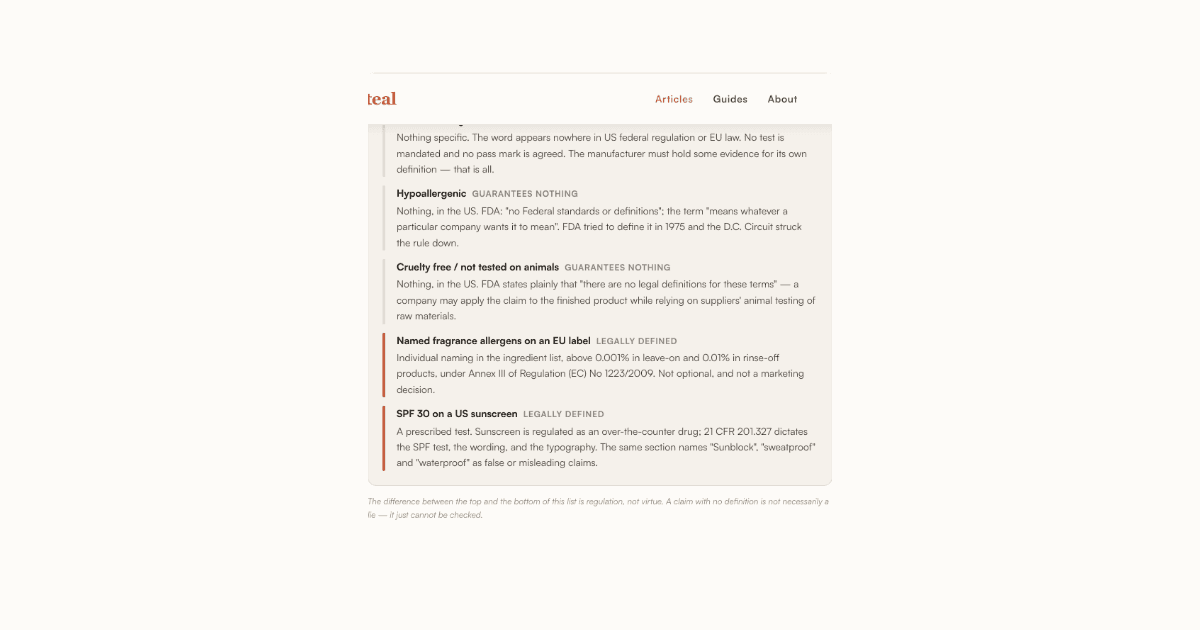
What 'Non-Comedogenic' Actually Guarantees
The word does not appear anywhere in US federal regulation, or in EU law. No test is required and there is no pass mark. Here is what the label is really telling you — and why dermatologists still say to look for it.
August 5, 2026
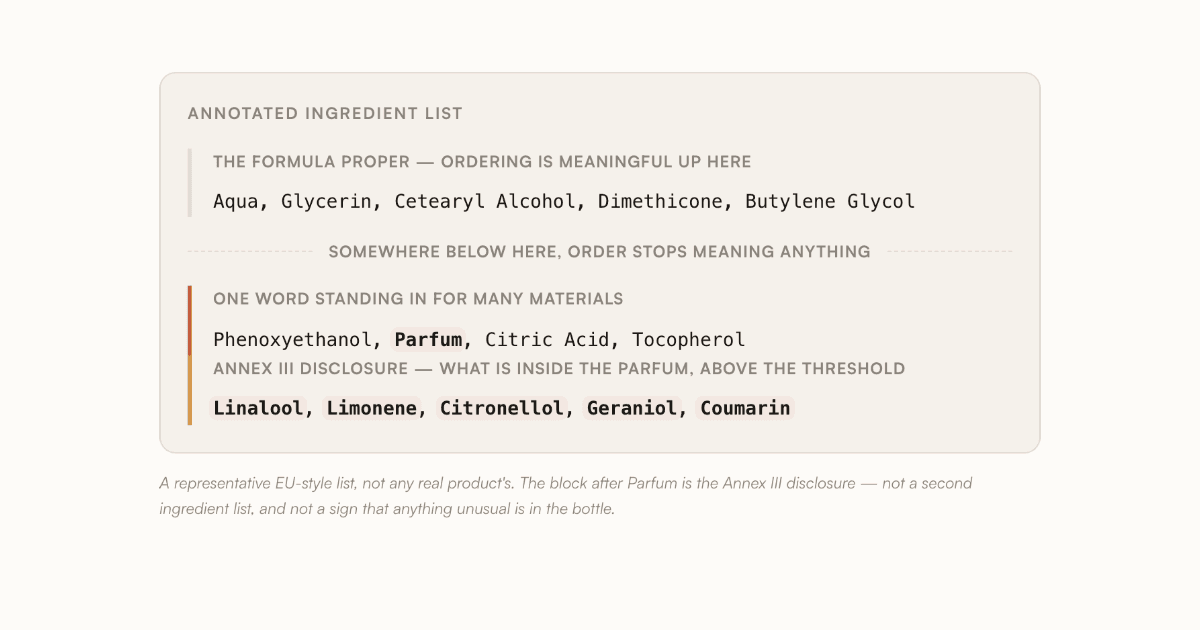
How to Spot Fragrance on an Ingredient List
The word to look for is 'Parfum' in the EU and 'Fragrance' in the US — and the chemical names sitting after it are not a separate ingredient list. Also: the '26 EU allergens' figure everyone quotes has been wrong since 2022.
August 3, 2026
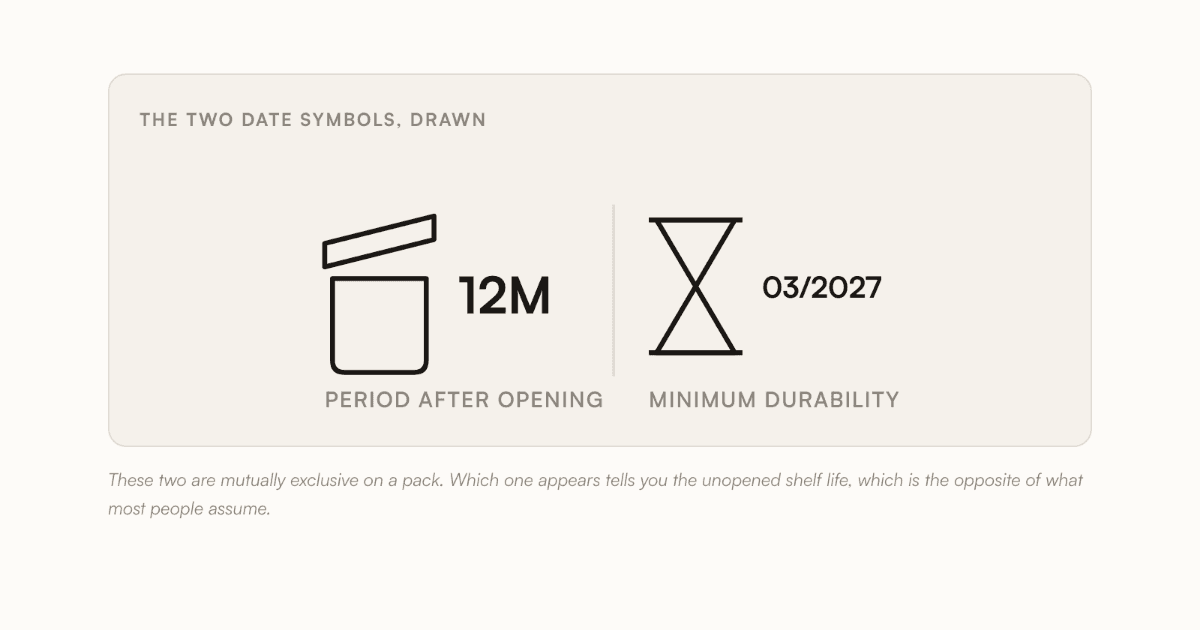
What the Open-Jar Symbol on Your Makeup Actually Means
The little jar with '12M' on it tells you more than you think — and its absence tells you something too. What the law actually requires, in the EU and the US.
August 6, 2026