Why your mascara smudges under your eyes — and what the formula type has to do with it
Smudging happens when moisture meets a water‑attracting film, skin oils dissolve the binder, or curled lashes touch the lower lid too often. The formula’s resistance claims point to which of these is at play.
GlowSteal Editor
Frequent makeup smudging occurs because of the hydrophilic properties of mascara and the improper curvature of eyelashes when exposed to sweat, rain, or tears during blinking (study).
That single sentence captures the three forces that create those grey‑black marks under your eyes: water‑attracting films that weaken in humidity, a lash shape that presses colour onto the skin, and oils — from your face or eye cream — that dissolve the binders holding the pigment. Which of these is doing the most damage depends on what your mascara tube promises to resist.
Your lashes were built to shed moisture, not to hold a curl
The primary role of eyelashes is to protect and maintain the health of the lid margin, one review notes.
Previous experiments reveal that the hydrophobicity and the downward‑inclined curved flexible fiber array structure of natural eyelashes endow them with functional superiority in water drainage (research).
Modern beauty standards often encourage practice such as clipping, rolling, or even perming eyelashes to obtain an upward curvature and using hydrophilic mascara to extend and fix eyelashes. It compromises the protective functions due to covering or damaging the scale‑like cuticle on eyelashes.
The mean angle between the lash follicle root and the skin epithelium was 75 ± 11 degrees and similar in both ethnic groups.
The eyelash bulb was located close to the tarsal plate and meibomian glands and formed an angle of less than 15 degrees with the eyelash root.
Natural lashes curve downward and work like a drain; water runs off. When you curl them upward and coat them with a water‑attracting film, the lash tips are more likely to press against the lower lid during a blink. Combined with the oil from the nearby meibomian glands, the moisture‑softened film makes pigment transfer almost inevitable.
How moisture attacks the mascara film
Water‑resistance or waterproofness is particularly desirable for cosmetics such as mascara because human secretions, such as sweat, tears and the like; and moisture such as rain and snow, which the user is likely to encounter daily, can interact with the mascara and cause running or removal (patent).
As a result, frequent makeup smudging occurs because of the hydrophilic properties of mascara and the improper curvature of eyelashes when exposed to sweat, rain, or tears during blinking.
Waterproof mascaras have been developed utilizing water based acrylic polymers. While these mascaras are waterproof and provide soap and water washability, they demonstrate poor performance, (i.e., smudging, flaking, etc. commonly occur) due to the incompatibility of the acrylic polymer with the other components of the formulation (patent).
There was a positive correlation between the frequency of mascara use and the degree of cracking in cuticle (study).
The positive correlation was also found between the frequency of mascara use and the porosity of the cortex.
A damaged, more porous lash surface absorbs moisture unevenly and lifts the film, while a film that isn’t cross‑linked strongly against water can start to smear even in high humidity.
The oil factor: why your skincare can cause smudges
“Smudge Resistant” as used herein refers to the ability to repel hydrocarbon oil and permanence with respect to hydrocarbon oil (patent).
For example, a mascara composition may be applied to false eyelashes, which may then be placed in hydrocarbon oil for a certain amount of time, such as, for example, 20 minutes.
The eyelash bulb was located close to the meibomian glands.
The width of the cuticle layer varied between the hair shaft and the inner eyelid segment (anatomy study).
If the label does not promise smudge resistance, oil from your own eyelids and from face creams can dissolve the waxes and polymers, and blinking massages those oils downward along the lash line.
How you apply it matters
The diversity of feminine eyelashes appears as a major influencing factor in the application of mascaras and their related results (research).
Standard applications by trained aestheticians led to higher and more homogeneous deposits of mascara, as compared to those resulting from self‑applications.
Uneven, clumpy self‑application can leave heavy spots that deposit more pigment onto the lower lid, so a thin, even coat may reduce contact transfer.
What your mascara’s formula type actually means for smudging
“Waterproof” as used herein refers to the ability to repel water and permanence with respect to water, while “Smudge Resistant” refers to the ability to repel hydrocarbon oil (patent).
It has been surprisingly discovered that the composition of the present invention is capable of imparting improved waterproof and smudge‑resistant properties onto lashes treated therewith, while at the same time being easily washed from the lashes with water, all in the absence of latex film formers, other synthetic film formers or emulsifiers.
Although not being limited by theory, it is believed that when the solvent evaporates the mascara composition “drys” and forms a crosslinked dimethicone/silica copolymer film (patent).
These definitions mean a mascara that claims only “waterproof” can still transfer pigment when it meets facial oil, while a “smudge‑resistant” claim targets oil but says nothing about rain or tears. The removal method often reveals which enemy the film is built for.
How removal method points to the cause of smudging
Yet, the composition is easily removed with the use of simply soapy water (patent).
Those skilled in the art are well aware that most waterproof mascaras either have a heavy feel, smudge or flake easily, are difficult to remove, or have a potential for loss of eyelash or eyebrow hair.
If your mascara washes off with just water, moisture is the likely smudge trigger. If it demands an oil‑based remover, the film is probably hydrophobic but susceptible to skin oils. A formula with both claims that is still water‑removable tries to handle both, though no film is perfectly impenetrable.
What to look for next time
Check the tube for the words “smudge‑resistant” or “smudge‑proof” separately from “waterproof”. If only waterproof is claimed, keep rich eye creams and facial oils away from the orbital bone before makeup.
If your natural lash direction is very straight or downward‑curling, avoid extreme mechanical curling that forces the lashes to press against the lower lid; a more subtle lift can reduce contact transfer.
On high‑humidity days, a formula that is both waterproof and smudge‑resistant, removed with an oil‑based cleanser, offers protection against both sweat and sebum.
What we could not establish
-
Specific evidence on tubing (polymer‑encapsulating) mascara formulas and their mechanism of smudge resistance. No record in the evidence set described tubing technology or its behaviour under oil or moisture, so we could not include it in the comparison table despite its frequent discussion in consumer media.
-
Published in‑vivo measurements of how much facial oil or eye cream migrates onto the lash line over the course of a day. We found patent definitions that treat smudge resistance as oil repellency, but no quantitative study reporting the rate or amount of oil transfer to lashes in a real wear test, so the contribution of skincare migration is inferred rather than measured.
-
A regulatory or standards body definition that separates “water‑resistant” from “waterproof” for eye‑area cosmetics. The records contain patent‑level definitions only; no mandatory legal distinction was present, which means labelling is manufacturer‑driven and not uniformly standardised.
-
Sources we could not use. pubmed.ncbi.nlm.nih.gov (the page was read but no verbatim passage relevant to this brief could be cut from it); doi.org (HTTP 403 — host refused automated access); patentimages.storage.googleapis.com (not a primary source); patents.justia.com (not a primary source); www.freepatentsonline.com (not a primary source); doi.org (HTTP 200 but only 11 chars of text (2705 bytes raw)). Nothing above rests on any of them.
Sources consulted, retrieved 2026-08-10:
-
Rapid water drainage on human eyelashes of a hydrophobic Brachistochrone fiber array
-
WO2010077891A2 - Washable waterproof and smudge-resistant mascara
GlowSteal has not tested any product for this article. Every quotation and every figure above was taken from a page this site fetched and stored on 2026-08-10; this is general information, not medical advice.
Enjoyed this post?
Get more like it delivered every Tuesday.
You might also like
Why Foundation Separates Around Your Nose
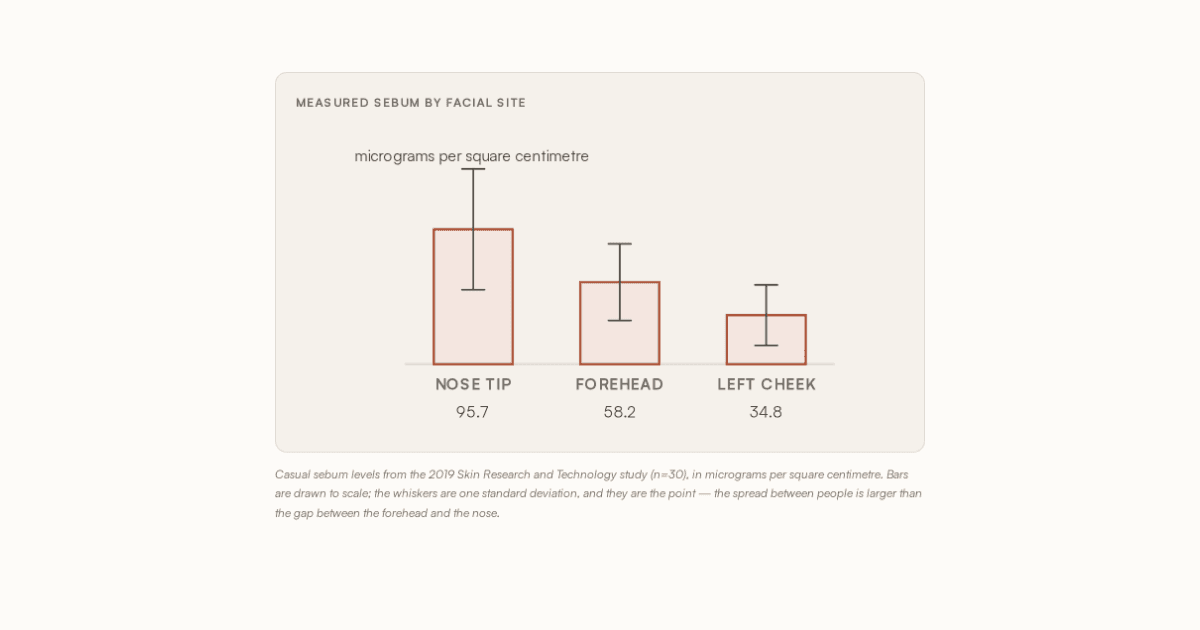
The nose is measurably the oiliest part of the face — around three times the cheek in one study. That much is established. The explanation everyone gives for why makeup breaks up there is not.
August 8, 2026
Why Your Face Looks White in Flash Photos
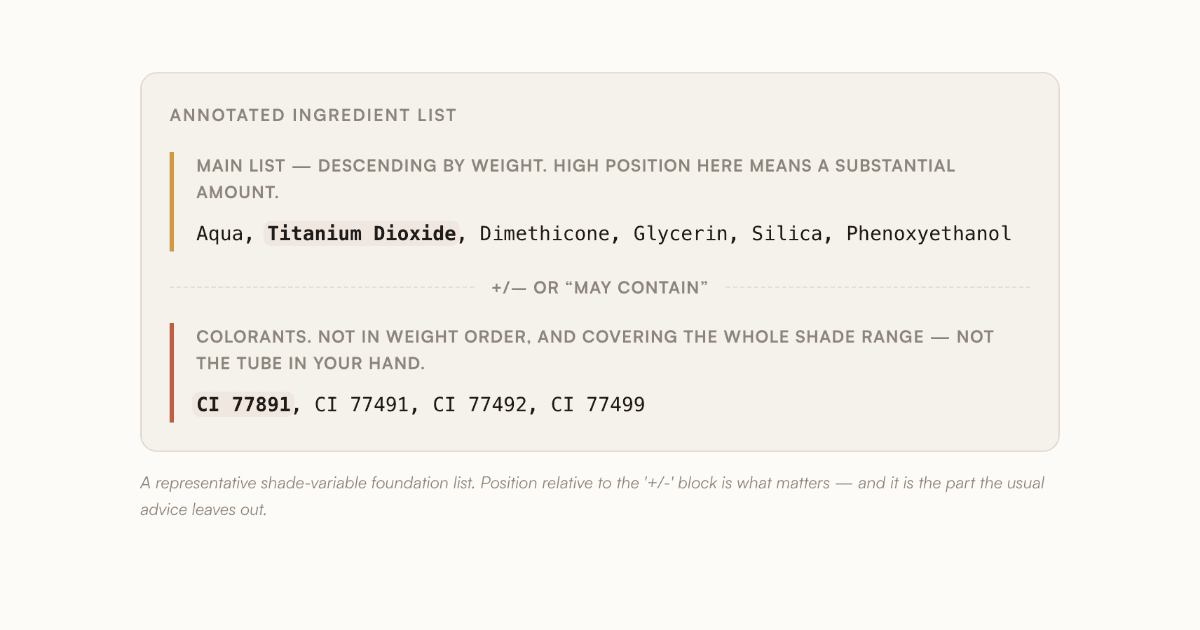
The flash doesn't cause it. The white cast is there in ordinary light too — the flash just makes it obvious. And the usual advice, including avoiding 'nano' and dropping SPF, points the wrong way.
August 5, 2026

Why Makeup Pills Over Sunscreen
The only clinical study of pilling found it happens at the sunscreen step, not the makeup step — and that foundation usually fixes it. Almost everything else you've read about this has no evidence behind it.
August 3, 2026