Why Your Face Looks White in Flash Photos
The flash doesn't cause it. The white cast is there in ordinary light too — the flash just makes it obvious. And the usual advice, including avoiding 'nano' and dropping SPF, points the wrong way.
GlowSteal Editor
Two ingredients are responsible: titanium dioxide and zinc oxide. Both have an unusually high refractive index, which makes them scatter visible light strongly — which is exactly why titanium dioxide is the standard white pigment in almost everything.
But the most useful thing to know is that the flash is not doing what you think.
Nobody has published a study of makeup flashback. We looked specifically, and there is no peer-reviewed literature on the phenomenon by that name.
What does exist is a solid body of work on how titanium dioxide and zinc oxide scatter visible light — measured in sunscreen and pigment research — plus ordinary camera optics. Everything below is one of those two things, or clearly marked as our reasoning joining them up. Where we are inferring, we say so.
The flash doesn't create the white cast
A 2025 study in PLOS ONE measured white cast from zinc oxide at 10%, 20% and 30% on skin and on a synthetic skin substrate. The measurement setup had no flash at all — a colorimeter inside a light box lit by continuous LEDs at 6500K, with a colour-correction card in every frame.
The cast was measurable and visible under steady light. So it is not something the flash produces. It is there in the mirror, in daylight, in the office. What a flash changes is how obvious it is, not whether it exists.
The clincher is a different study, which photographed sunscreened faces using an electronic flash and a UV-converted camera.
Sunscreen-covered skin came out darker, not whiter. As the authors explain, "UV light is absorbed by melanin and sunscreen, so areas of high pigment or sunscreen coverage appear darker in these photographs".
Same materials, same flash, opposite outcome — because the camera was recording ultraviolet instead of visible light. The variable is wavelength, not flash. These ingredients scatter visible light and absorb ultraviolet.
Our inference, stated as such: a built-in flash sits within a few centimetres of the lens, so the sensor occupies almost exactly the direction light is scattered back toward. At portrait distances the flash also overwhelms ambient light, and the camera's exposure meters the whole scene rather than your face. Those three things plausibly explain why a flash makes an always-present effect leap out. That is standard optics and camera behaviour — but we found no study measuring it for a cosmetic film, and we are not going to present reasoning as a result.
"It reflects the flash like a mirror" is wrong twice over
First, for visible light — the only band an ordinary camera records — every source we could read describes diffuse scattering by very many small particles. That is optically not the same thing as specular reflection off a surface. Nothing is behaving like a mirror.
Second, for ultraviolet, the mechanism is genuinely disputed in the literature. A 2024 review in the Journal of Clinical Medicine states that physical filters work by "reflecting and scattering UVA and UVB radiation." Against that sits a much-cited 2016 paper whose title is Metal oxide sunscreens protect skin by absorption, not by reflection or scattering.
We could not obtain that 2016 paper — every route to it was paywalled or blocked — so we are not repeating the specific figures attributed to it. But an explanation contradicted by a paper's title is not one to state as settled.
Particle size works backwards from the intuition
This is the part that makes the common advice actively counterproductive.
Scattering of visible light is not "more material, more white" in a simple way. It depends sharply on particle size, and it peaks and then collapses. From a study of titanium dioxide pigment sizing:
"In the case of TiO₂ with a refractive index of 2.5–2.9 (depending on the crystal structure), the optimum particle size for visible light scattering is around 200 nm"
and below a threshold "which is around 105–115 nm":
"the scattering power of the particles decreases significantly, and the material can no longer be used effectively as a white pigment"
Read that again with the label in mind. Nano-grade mineral filter means less visible whitening, not more. Particles small enough to be labelled (nano) are below the size that scatters visible light well.
In the EU, Article 19 of Regulation (EC) No 1223/2009 requires that "All ingredients present in the form of nanomaterials shall be clearly indicated in the list of ingredients. The names of such ingredients shall be followed by the word 'nano' in brackets."
That is a genuine, legally meaningful signal. But if your goal is less white cast, (nano) is the label you want to see, not the one to avoid. Whatever else you may think about nanomaterials, on this specific question the popular advice optimises in the wrong direction.
In practice the particles do not stay separate anyway — the 2025 study notes that zinc oxide and titanium dioxide in sunscreens form aggregates that clump together in the range of 0.1 to 10 micrometres. Larger clumps sit further into the size range that scatters visible light.
Silica probably isn't a culprit
Silica appears on nearly every list of "flashback ingredients". We found no primary evidence for it, and a reason to doubt it.
Scattering depends on the contrast in refractive index between a particle and whatever surrounds it. Titanium dioxide is 2.5–2.9. Silica sits far lower and close to the oils, esters and silicones it is suspended in — so there is very little contrast to scatter from. A cosmetic patent on soft-focus formulations files silica in an explicitly different category from "powders with a high refractive index such as titanium dioxide, zinc oxide and iron oxide".
Silica's job in makeup is soft-focus blurring and oil absorption. We are not saying it is definitely innocent — we are saying we could not find a single primary source implicating it, and the physics does not obviously support it.
Dropping the SPF may not fix it
This is the advice everyone gives, and it rests on an inference nobody appears to have tested.
The premise is sound as far as it goes. SPF has genuinely migrated into makeup — an FDA proposed rule notes that "other widely used products, such as facial makeup, moisturizing creams, and lipsticks, have had sunscreen active ingredients added to their formulations" — and both minerals are permitted at up to 25% as UV filters. That is a lot of scattering material.
But titanium dioxide is also the standard white pigment in any foundation, SPF or not. It is listed independently as a permitted colorant, CI 77891, described in the regulation simply as "White". A foundation with no sun protection claim whatsoever routinely contains it, because that is what gives a foundation its opacity.
We could not find any study comparing photographic appearance between SPF and non-SPF makeup, or apportioning the effect between UV-filter titanium dioxide and colorant titanium dioxide. Every source making the "SPF is the culprit" claim that we located was a beauty blog or a brand page.
So: SPF makeup is a plausible and possibly large contributor. That it is the cause, and that switching to a non-SPF foundation fixes the problem, is unverified.
Reading the label — with the caveat that undercuts it
Aqua, Titanium Dioxide, Dimethicone, Glycerin, Silica, Phenoxyethanol
CI 77891, CI 77491, CI 77492, CI 77499
The rule that follows:
Titanium DioxideorZinc Oxidehigh in the main list, before the+/-— a substantial amount is present. This is the signal worth acting on.CI 77891appearing only after+/-or "may contain" — tells you titanium dioxide may be in your shade, and nothing at all about how much. Article 19 lets shade-variable decorative cosmetics list colorants outside weight order, covering the entire shade range rather than the individual product.(nano)after either name — less visible scattering, not more.- Silica's position is not worth reading for this, on the evidence we could find.
The popular instruction to "check the ingredients for titanium dioxide" is therefore only reliable in case 1. In case 2, the label has been designed in a way that cannot answer the question.
The test that settles it without any of this: photograph yourself with a flash before you leave, in the makeup you plan to wear. It takes ten seconds and it measures the thing you actually care about, which no ingredient list can tell you.
One thing the coverage usually misses
The 2025 study found white cast more apparent on deeper skin tones, and frames it explicitly as a compliance problem — noting that white cast "often deters consumers from complying with sunscreen application directions, especially those with darker complexions."
That is a contrast effect rather than a difference in the product: a film that returns broadly white light sits further from the underlying skin colour on deeper skin, so the same layer reads as a bigger mismatch. It is worth naming, because "just use less" is not equally good advice for everyone, and because sunscreen compliance matters more than a photograph does.
That study measured sunscreen on forearms and a synthetic substrate, not foundation on faces. We are not stretching it further than that.
What we could not establish
- Anything about makeup flashback specifically. There is no literature on it. The bridge between the scattering research and a camera flash is our reasoning, and is marked as such above.
- The angular geometry. No study measures how light scatters from a cosmetic film toward a camera. The backscatter explanation is inference from standard optics.
- The absorption-versus-reflection dispute for UV. The key 2016 paper was unreachable through every route we tried, so we have quoted nothing from it and repeated none of the figures attributed to it.
- Whether SPF makeup is worse than non-SPF makeup for this. Nobody appears to have compared them.
- Silica's exact refractive index in the visible range from a primary source. The reasoning above rests on the contrast principle and on a patent's categorisation, not on a measured value we obtained.
- The US labelling route. SPF makeup is legally an over-the-counter drug in the US and should carry a Drug Facts panel naming actives with percentages — but every FDA labelling page and CFR mirror refused our requests, so we have not stated that as verified.
Sources consulted, retrieved 28 July 2026:
- Maldonado López AM, Gallagher EA, Curry A, et al. PLOS ONE 2025 — white cast from zinc oxide, measured under continuous lighting, across skin tones.
- Comparative electron microscopy particle sizing of TiO₂ pigments — refractive index, the 200 nm scattering optimum and the 105–115 nm threshold.
- Pratt H, Hassanin K, Troughton LD, et al. PLOS ONE 2017 — UV photography of sunscreened skin.
- Breakell T, Kowalski I, Foerster Y, et al. J Clin Med 2024;13(10):2986 — UV filter review, cited for the reflecting-and-scattering position in the dispute.
- Faure B, et al. Sci Technol Adv Mater 2013 — nanoparticle size and transparency.
- Regulation (EC) No 1223/2009, Article 19 and Annex IV — descending weight order, the (nano) requirement, and titanium dioxide as colorant CI 77891.
- FDA proposed rule, Sunscreen Drug Products for Over-the-Counter Human Use, 26 Feb 2019, via GovInfo.
- WO2020234038A1 (Unilever), a soft-focus formulation patent, cited only for how it categorises silica against high-refractive-index powders — for mechanism, never for efficacy.
Concentration figures quoted here are regulatory maxima, not statements about any product's contents. GlowSteal has not tested any product for this article. General information, not medical advice — and please do not skip sunscreen over a photograph.
Enjoyed this post?
Get more like it delivered every Tuesday.
You might also like
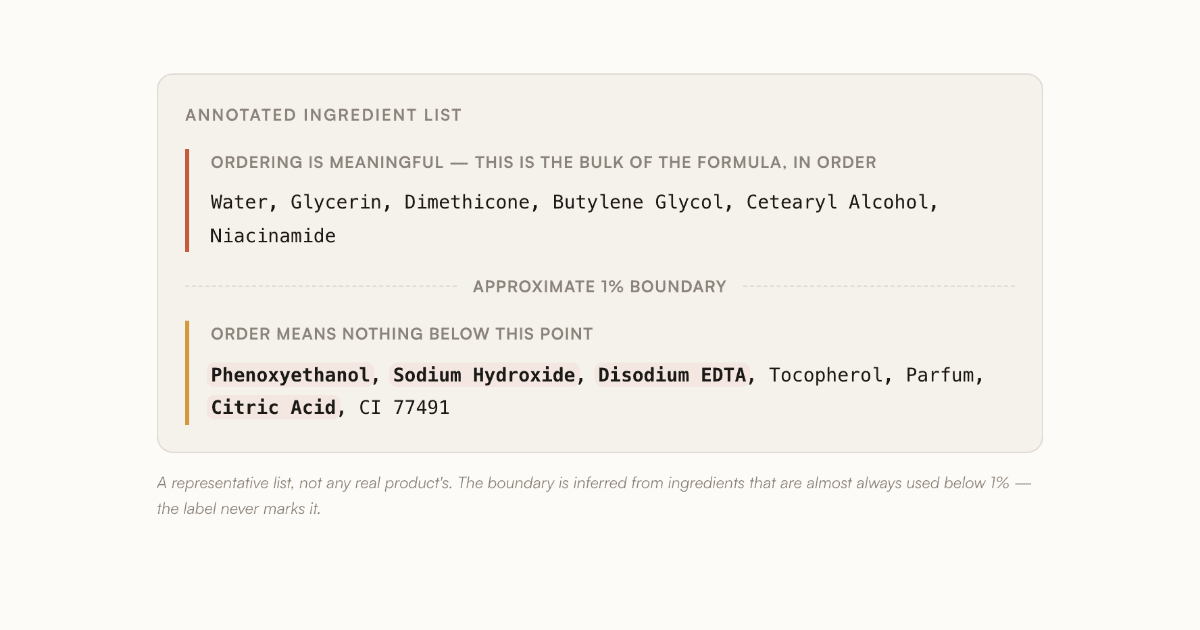
How to Read a Cosmetic Ingredient List
Ingredient lists are ordered by weight — until they aren't. The 1% rule is the single most useful thing to understand, and it's the thing most often explained wrongly.
July 31, 2026

Why Foundation Turns Orange or Darker
It isn't oxidation — the pigments are already oxidised and have nowhere to go. What actually happens is that the film turns more see-through, so your own skin shows through it.
August 2, 2026
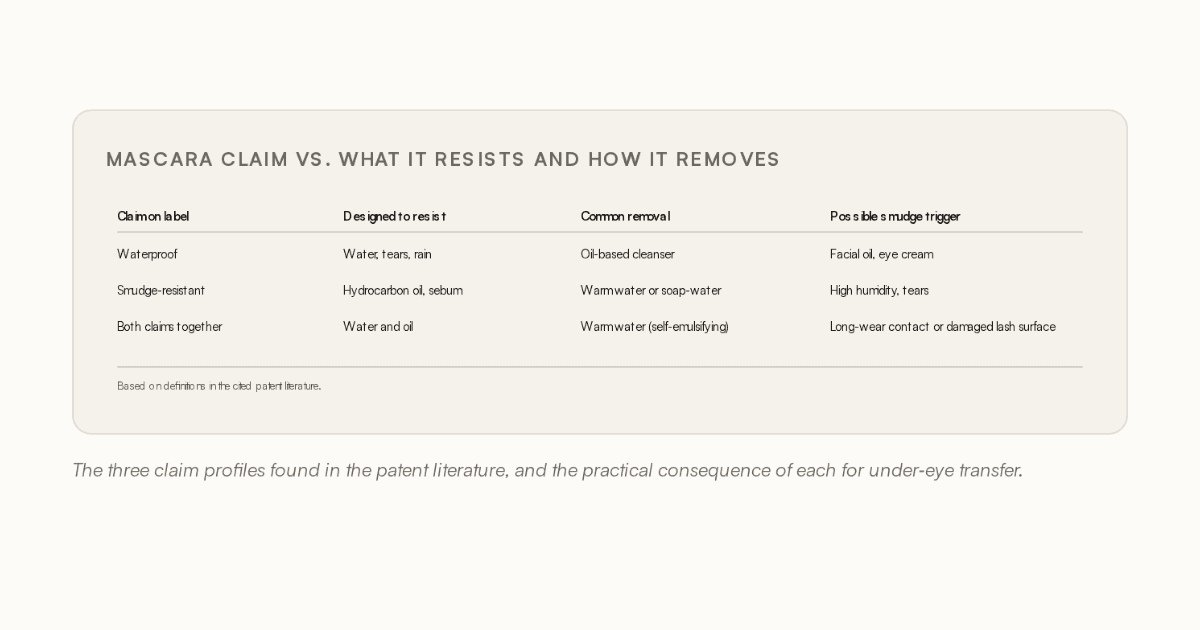
Why your mascara smudges under your eyes — and what the formula type has to do with it
Smudging happens when moisture meets a water‑attracting film, skin oils dissolve the binder, or curled lashes touch the lower lid too often. The formula’s resistance claims point to which of these is at play.
August 10, 2026