Why Foundation Separates Around Your Nose
The nose is measurably the oiliest part of the face — around three times the cheek in one study. That much is established. The explanation everyone gives for why makeup breaks up there is not.
GlowSteal Editor
Foundation breaks up around the nose before it breaks up anywhere else because that is where your skin puts the most oil. In one measurement study the nose tip carried nearly three times the sebum of the cheek.
That part is measured. The part you will read everywhere else — that separation happens because a water-based product and a silicone-based product "refuse to mix" — we could not trace to a single primary source, and we went looking.
The nose really is the oiliest site on your face
A 2019 study measured casual sebum levels at three points on the faces of thirty young adults with normal skin, using a Sebumeter:
"The mean±SD sebum amounts in different areas of the face were as follows: forehead, 58.2±27.2 μg/cm2; nose, 95.7±42.9 μg/cm2; and left cheek, 34.8±21.5 μg/cm2."
The nose tip came out highest, and the cheek lowest, by a wide margin. If you have ever noticed that your base survives perfectly well across the cheekbone while collapsing beside the nostril, that gap is the simplest explanation available, and it does not require anything to be wrong with your products.
A "casual sebum level" is how much oil is sitting on the surface at the moment of measurement. It is not a rate, and it is not a prediction of how much oil will arrive over the eight hours you are wearing makeup.
The study also has the limits its own authors describe. Thirty people: "Thirty subjects, including 18 men (60%) and 12 women (40%) with a mean age of 22.3±1.0 years were recruited for this study." Sebum output changes with age, so a group averaging twenty-two years old is not a stand-in for everyone. The standard deviations are large — nearly half the mean at the nose — which is a measured way of saying that people differ from each other more than the regions differ on any one face.
Absolute numbers move a lot between studies
It is worth seeing a second measurement before treating any single figure as the number for a facial region.
A separate study measured the same two of those sites in twenty-nine women and reported the forehead at 96.17 μg/cm² against the cheek at 38.12 μg/cm² — a forehead reading roughly two-thirds higher than the first study's, with a cheek reading close to it.
The two agree on the thing that matters here: the cheek is the least oily site measured, by a long way. They disagree substantially on the absolute values, which is what you should expect from different people, different rooms and different times of day. Treat the direction as established and the exact figures as one study's arithmetic.
The mechanism is where the evidence runs out
The standard explanation online is confident and mechanical: silicone-based and water-based products cannot mix, so one sits on top of the other, refuses to bond, and rolls off.
We looked for a source for that and did not find one. What returned instead was retailer copy, supplier marketing and beauty blogs repeating each other. None of that is evidence, and this site does not launder it into evidence by citing the most respectable-looking version.
The nearest peer-reviewed work we could actually read is a 2022 comparison of two otherwise-identical oil-in-water emulsions, one built with silicones and one without. It found that the silicone versions scored better on sensory measures and behaved differently on stability, and — the part everyone skips — that they were not occlusive: "The monitoring of TEWL over time demonstrated non-occlusive properties of emulsions containing silicones, the values of which were comparable to the negative control."
That study is about one formula at a time. It says nothing whatsoever about what happens when you put a second product on top of the first, which is the entire question. We are citing it to show what the literature does cover, not to imply it answers something it does not.
It would be easy to write the confident version. It reads better, it is what you came for, and nobody would check.
That is exactly the failure this site was rebuilt to avoid. The observation that water and silicone are immiscible is true chemistry, and it has been stretched into an unsourced claim about cosmetic films on a face. If someone can point us at a study that measured layered cosmetic films separating, we will write that article. Until then this is a gap, and it is labelled as one.
Telling the two formula types apart on the label
You can at least identify what you are layering, which is more than the mechanism story gives you. Ingredient lists run in descending order of concentration down to the one per cent mark, so what sits at the top of the list tells you what the product is mostly made of.
| What you see near the top | What it usually indicates |
|---|---|
| Water or aqua listed first | A water-continuous formula — most lightweight serums, gels and fluid bases |
A name ending in -cone or -siloxane high in the list, such as dimethicone | A silicone-rich formula — most blurring primers and many long-wear bases |
| A named oil or ester before either of the above | An oil-continuous or anhydrous formula — many balms, sticks and cream bases |
This is a reading skill, not a compatibility test. It tells you which two things you are putting together. It does not tell you they will fight, because nobody has shown us that they do.
What we could not establish
- Why separation happens at all. No primary source we could reach describes, measures or photographs two cosmetic films separating on skin. The mechanism repeated across the internet is unsourced as far as we can tell.
- Whether product order changes anything. Follows from the above. If the mechanism is unestablished, advice derived from it is too, so we are not giving you a layering order and calling it a fix.
- Whether waiting between layers helps, or for how long. We found no measurement of wait time against separation. Any specific number of minutes you have been told is not one we could source, and we are not repeating it.
- Whether the nose's oil is the cause rather than a correlate. The sebum measurements and the separation complaint sit on the same part of the face. Nobody we could find has tested whether reducing sebum at the nose reduces separation there.
- Sebum at the sides of the nose specifically. The study measured the nose tip. The crease beside the nostril, which is where people actually report the problem, was not measured.
- How any of this behaves on mature, dry or treated skin. The study population averaged twenty-two years old, and we found nothing comparable for other groups.
Sources consulted, retrieved 8 August 2026:
- The Correlations between Follicular Fluorescence and Casual Sebum Levels in Subjects with Normal Skin — Skin Research and Technology, 2019. The three-site sebum measurements, the sample description and the Sebumeter method.
- Sebum and Hydration Levels in Specific Regions of Human Face Significantly Predict the Nature and Diversity of Facial Skin Microbiome — Scientific Reports, 2016. The independent forehead and cheek measurements used for comparison.
- A comparison between silicone-free and silicone-based emulsions: Technological features and in vivo evaluation — Journal of Cosmetic Dermatology, 2022. What silicones do inside a single formula, and the occlusivity finding.
GlowSteal has not tested any product for this article and owns none. Sebum measurements are laboratory readings on small groups, not a description of your face. General information, not medical advice.
Enjoyed this post?
Get more like it delivered every Tuesday.
You might also like

Why Makeup Pills Over Sunscreen
The only clinical study of pilling found it happens at the sunscreen step, not the makeup step — and that foundation usually fixes it. Almost everything else you've read about this has no evidence behind it.
August 3, 2026
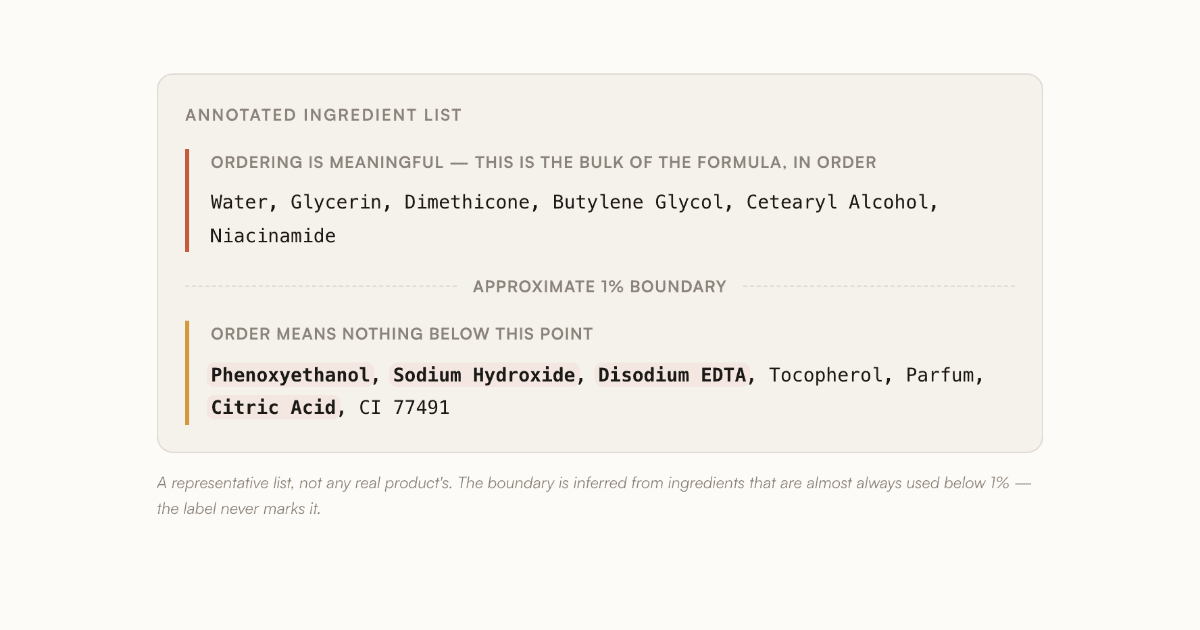
How to Read a Cosmetic Ingredient List
Ingredient lists are ordered by weight — until they aren't. The 1% rule is the single most useful thing to understand, and it's the thing most often explained wrongly.
July 31, 2026
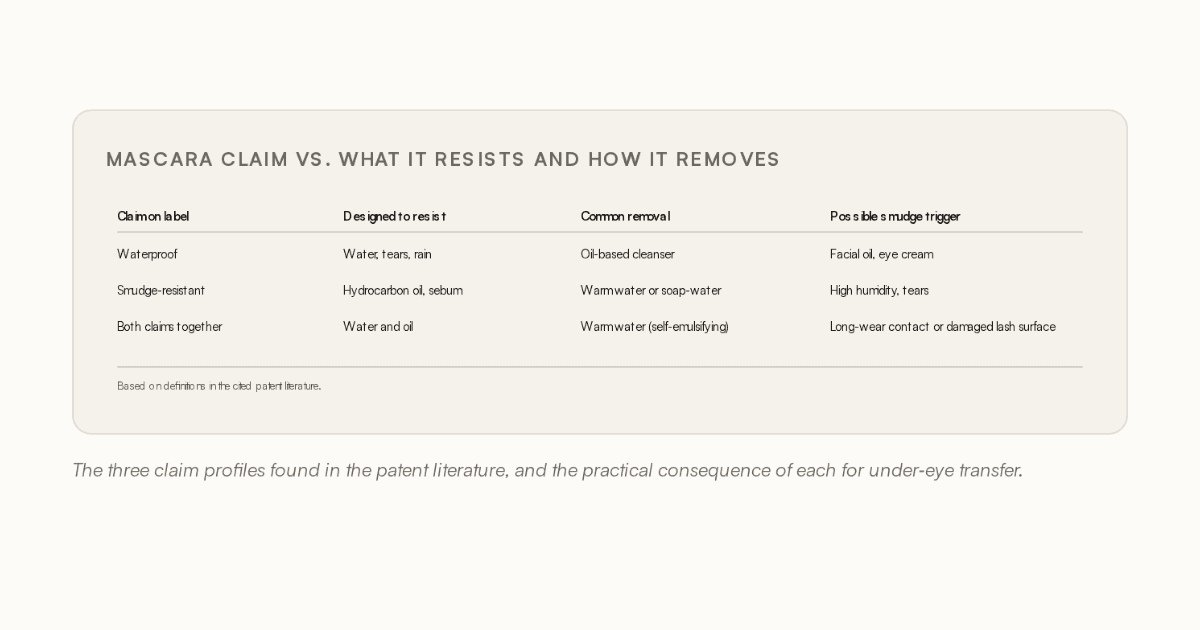
Why your mascara smudges under your eyes — and what the formula type has to do with it
Smudging happens when moisture meets a water‑attracting film, skin oils dissolve the binder, or curled lashes touch the lower lid too often. The formula’s resistance claims point to which of these is at play.
August 10, 2026