How to Read a Cosmetic Ingredient List
Ingredient lists are ordered by weight — until they aren't. The 1% rule is the single most useful thing to understand, and it's the thing most often explained wrongly.
GlowSteal Editor
An ingredient list is ordered by descending weight — most of it first, least of it last. That single fact does most of the work.
The complication, and the reason so much online advice about ingredient lists is subtly wrong, is that the ordering rule stops applying partway down. Below 1% concentration, ingredients can be listed in any order at all. Everything useful about reading a label follows from understanding where that line falls.
The rule, in both markets
The EU and the US arrived at nearly the same requirement.
EU — Regulation (EC) No 1223/2009, Article 19 requires the list be "established in descending order of weight of the ingredients at the time they are added to the cosmetic product", and then states plainly:
"Ingredients in concentrations of less than 1 % may be listed in any order after those in concentrations of more than 1 %."
US — 21 CFR 701.3(a) requires that the label "bear a declaration of the name of each ingredient in descending order of predominance, except that fragrance or flavor may be listed as fragrance or flavor."
The 1% provision is in paragraph (f), and it is worded more carefully than it is usually reported:
"As an alternative to listing all ingredients in descending order of predominance, ingredients may be grouped and the groups listed in the following manner and order: (1) Ingredients, other than color additives, present at a concentration greater than 1 percent, in descending order of predominance; followed by (2) Ingredients, other than color additives, present at a concentration of not more than 1 percent, without respect to order of predominance; followed by (3) Color additives, without respect to order of predominance."
Note "as an alternative". In the US this grouping is something a manufacturer may do, not something it must do. So a US list might be in strict descending order all the way down, or it might be grouped — and nothing on the pack tells you which. That makes the boundary even less knowable than the EU version, where the sub-1% freedom always applies.
Note the EU wording: order is set by weight at the time ingredients are added, not in the finished product. For formulas where something evaporates off during manufacture, those are not the same thing.
Where the 1% line actually falls
Here is the part nobody tells you: the label does not mark the line. You have to infer it.
The usual approach is to look for ingredients that are almost always used at low concentration, and treat them as a rough boundary marker.
Water, Glycerin, Dimethicone, Butylene Glycol, Cetearyl Alcohol, Niacinamide
Phenoxyethanol, Sodium Hydroxide, Disodium EDTA, Tocopherol, Parfum, Citric Acid, CI 77491
The highlighted entries are the markers people use to locate the boundary: preservatives, pH adjusters and chelators are almost always present at well under 1%. Fragrance and colourants sit down there too.
If the ingredient a product is marketed on appears below the 1% boundary, its position in the list tells you nothing about how much is there. It could be sitting at 0.9% or at a trace.
This is the single most common way ingredient lists get over-interpreted — in both directions. An ingredient appearing "high up" in the sub-1% zone has not been shown to be present in a meaningful amount, and one appearing "low down" has not been shown to be absent in a meaningful amount. Below the line, the order is simply not information.
Even above the 1% line, a list tells you what is in a product and roughly in what proportion. It cannot tell you whether the product works.
Concentration, the rest of the formula, pH, and how the ingredient is delivered all affect the outcome, and none of them are on the label. Reading an ingredient list well means knowing what it can't tell you.
Fragrance is one word for many things
Both markets allow perfume compositions to be collapsed into a single term.
The EU regulation states that "perfume and aromatic compositions and their raw materials shall be referred to by the terms 'parfum' or 'aroma'", with certain substances required to be indicated additionally in the list. The US equivalent permits fragrance or flavour to be listed simply as fragrance or flavor.
Two practical consequences:
ParfumorFragrancemay represent many individual components, declared as one entry. If you are avoiding fragrance, that single word is the thing to look for.- In the EU you will sometimes see specific fragrance components named separately after the parfum entry — things like linalool or limonene. Those are the substances the regulation requires to be called out individually, and their appearance is a labelling requirement rather than a sign that something unusual is in the product.
"Unscented" and "fragrance-free" are not equivalent. A product can be unscented because a masking fragrance has been added to cover a raw-material smell — in which case a fragrance is present and should appear in the list. If you are avoiding fragrance, read the list rather than the front of the pack.
A practical reading order
- Read the first five. That is most of the formula. If a product is marketed as an oil but oil appears eighth, you have learned something.
- Find the boundary. Locate the preservative or pH adjuster and treat everything after it as unordered.
- Check where the hero ingredient sits relative to that boundary.
- Look for
parfum/fragranceif that matters to you, anywhere in the list. - Stop there. Beyond this, a list will not tell you how a product performs.
Where the names themselves come from
Ingredient names follow the INCI convention, but US regulation does not simply point at INCI. 21 CFR 701.3(c) sets out a precedence list — the sources a name must be taken from, in order:
- A name established by the Commissioner under § 701.30, if one exists
- CTFA Cosmetic Ingredient Dictionary, Second Edition, 1977
- United States Pharmacopeia, 19th Edition, 1975
- National Formulary, 14th Edition, 1975
- Food Chemicals Codex, 2nd Edition, 1972
- USAN 1975, the 1961–1975 cumulative list
- Failing all of those, "the name generally recognized by consumers"
- Failing that, "the chemical or other technical name or description"
The naming authority written into US cosmetic labelling law is a dictionary published in 1977, by a trade association that no longer exists under that name — the Cosmetic, Toiletry and Fragrance Association is now the Personal Care Products Council. The regulation still gives its Washington street address.
In practice the industry has moved on and labels follow current INCI naming, which the dictionary's successor editions maintain. But the frozen reference is why US ingredient names occasionally look archaic, and why the regulation's fallback tiers — "the name generally recognized by consumers", then the chemical name — exist at all. Anything introduced after 1977 arrives through § 701.30 or through those fallbacks.
What we could not establish
- How reliably the low-use markers above identify the 1% line. It is a widely used heuristic and a reasonable one, but it is inference from typical use levels, not something the label declares. Treat the boundary as approximate.
- Whether a given US list is grouped or strictly ordered. Because paragraph (f) is optional, a US label could be either, and it does not say which. We know of no way for a reader to tell from the pack.
Sources consulted, retrieved 28 July 2026:
- Regulation (EC) No 1223/2009, Article 19 — Labelling. Quoted for descending-weight ordering, the 1% provision, and fragrance declaration. Re-checked 28 July 2026 against the EU original served by the EU Publications Office (
publications.europa.eu/resource/celex/32009R1223), because legislation.gov.uk hosts UK-assimilated law rather than live EU text. Article 19(1)(g) is identical in both, including the sentence quoted above: "Ingredients in concentrations of less than 1 % may be listed in any order after those in concentrations of more than 1 %." - 21 CFR 701.3 — Designation of ingredients, via the eCFR versioner API. Quoted for descending-order declaration, the optional 1% grouping in paragraph (f), and the naming precedence list in paragraph (c). Updated 28 July 2026: an earlier version of this article said the primary text could not be reached. It can — the eCFR JSON API serves it even though the HTML site refuses automated requests. The section that was missing is now quoted directly, and the 1% rule is described more precisely as a result: in the US it is an alternative the manufacturer may take, not the default.
This describes EU and US requirements as we read them on the date above; regulation changes. General information, not legal or medical advice. GlowSteal has not tested any product for this article.
Enjoyed this post?
Get more like it delivered every Tuesday.
You might also like
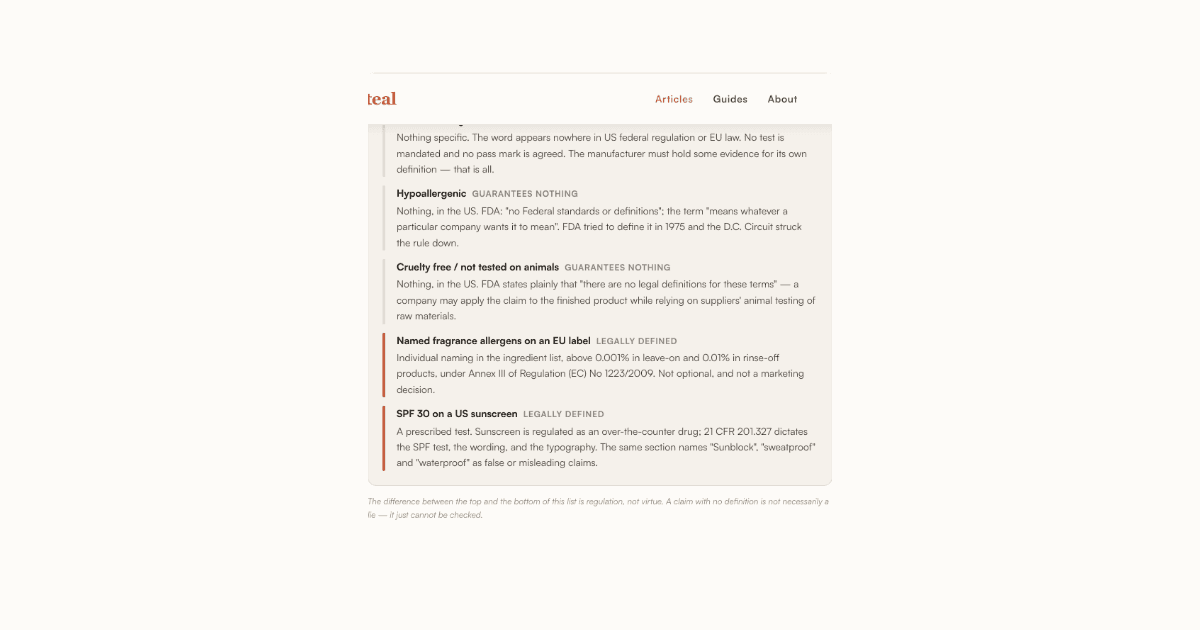
What 'Non-Comedogenic' Actually Guarantees
The word does not appear anywhere in US federal regulation, or in EU law. No test is required and there is no pass mark. Here is what the label is really telling you — and why dermatologists still say to look for it.
August 5, 2026
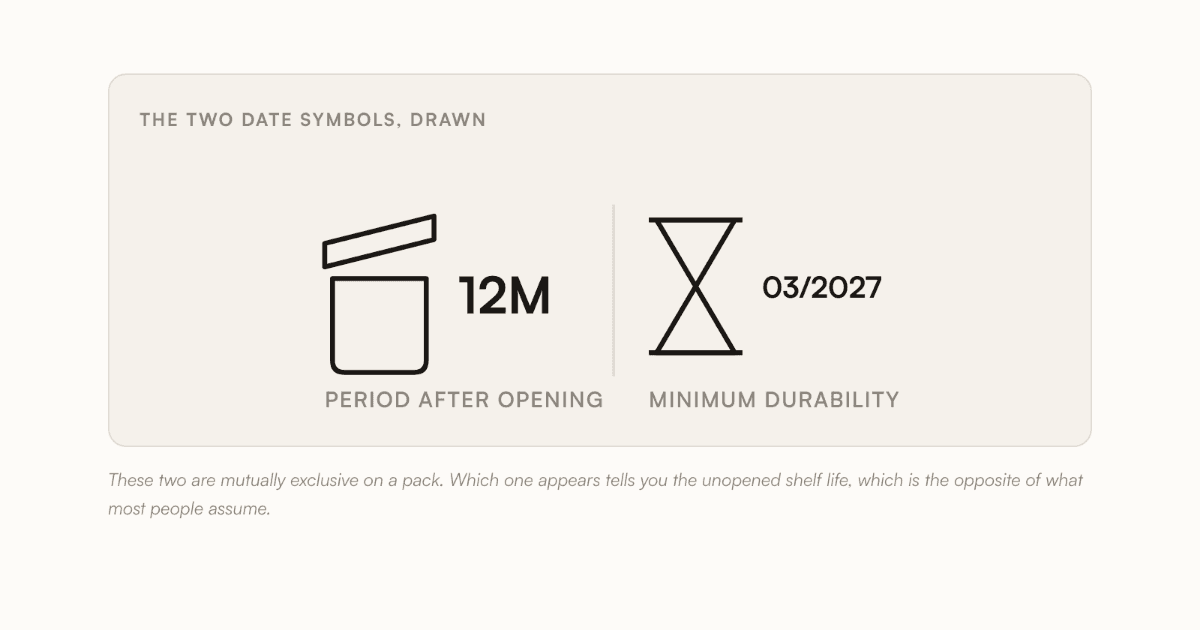
What the Open-Jar Symbol on Your Makeup Actually Means
The little jar with '12M' on it tells you more than you think — and its absence tells you something too. What the law actually requires, in the EU and the US.
August 6, 2026
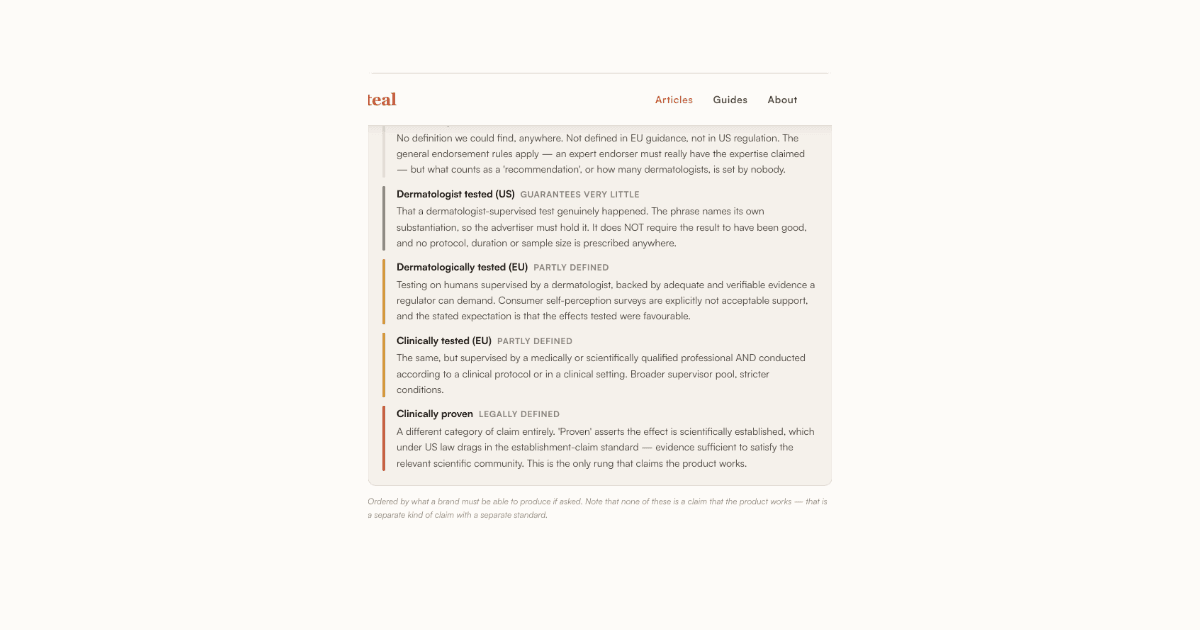
What 'Dermatologist Tested' Means on a Label
It is a claim about process, not result — and a European court ruled on exactly this phrase in 2002. What it obliges a brand to hold differs completely between the EU and the US.
August 4, 2026