What 'Non-Comedogenic' Actually Guarantees
The word does not appear anywhere in US federal regulation, or in EU law. No test is required and there is no pass mark. Here is what the label is really telling you — and why dermatologists still say to look for it.
GlowSteal Editor
"Non-comedogenic" guarantees that the manufacturer decided what the word means. That is the whole of it.
There is no legal definition of the term in the United States or in the European Union. No test is required before printing it. Where tests exist, there is no agreed pass mark. What the law does require — in both markets — is that a company hold some evidence for whatever it decided the word means. It just doesn't say what the word has to mean.
That sounds like a reason to dismiss the label. The awkward part, which most write-ups skip, is that the American Academy of Dermatology still tells acne patients to look for it. Both things are true, and the useful version of this article is the one that sits with that rather than picking a side.
The word isn't in the regulations. At all.
This is stronger than "the FDA hasn't defined it".
A full-text search of the entire US Code of Federal Regulations, through the eCFR search API, returns zero occurrences of comedogenic and zero of noncomedogenic. Searched on 28 July 2026.
A zero is only worth something if the search works, so: the same API returns 6 results for hypoallergenic and 78 for sunscreen. The query is fine. The word genuinely is not there.
The CFR is codified federal regulation — the binding rules, including FDA's at 21 CFR and the FTC's at 16 CFR. A zero there means no US regulation defines the term.
It does not cover FDA guidance documents, warning letters, or FTC enforcement under its general deceptive-advertising authority. "Not defined in regulation" is what we are claiming. "Nobody could ever be pursued over it" is a stronger claim and not one this search can carry — see the next section for what does apply.
The FDA's own Cosmetics Labeling Claims page says so from the other direction:
"The law does not require cosmetic labeling to have FDA approval before cosmetic products go on the market, and FDA does not have a list of approved or accepted claims for cosmetics."
That page then lists the specific claim terms FDA has bothered to publish guidance on — Alcohol Free, Cosmeceutical, Cruelty Free / Not Tested on Animals, Hypoallergenic, Organic. "Non-comedogenic" is not among them.
The EU is no different in substance, though it gets there differently. Regulation (EU) No 655/2013 sets six common criteria that every cosmetic claim must satisfy — legal compliance, truthfulness, evidential support, honesty, fairness, informed decision-making. It defines no specific wording, and the Commission's own technical document on cosmetic claims says that outright: the common criteria "are not aimed at defining and specifying the wording that can be used for cosmetic product claims."
The claim is unregulated as to meaning and regulated as to honesty.
In the US, the FTC's advertising substantiation policy requires a firm to hold a reasonable basis for an objective claim before it runs. In the EU, criterion 3 of Regulation 655/2013 requires claims to be "supported by adequate and verifiable evidence".
So a company cannot legally print the word having done nothing at all. It can decide for itself what the word means, run whatever test matches that decision, and print it. Those are very different protections, and only the second one is usually explained.
There is a hole here because someone tried, and lost
This is the part that almost never gets told, and it explains the vacuum better than "regulators haven't got round to it".
The FDA did once try to give a cosmetic marketing adjective a legal definition. Not this one — hypoallergenic. In 1975 it finalised a regulation permitting the term only where human studies showed a significantly lower rate of adverse reactions than competing products. Almay and Clinique sued, and the D.C. Circuit struck the rule down. The FDA's own account of where that leaves things is unusually blunt for a regulator:
"There are no Federal standards or definitions that govern the use of the term 'hypoallergenic.' The term means whatever a particular company wants it to mean."
Nothing in that judgment was about comedogenicity. But it settled the underlying question — who gets to decide what a cosmetic marketing word means — and the answer was: not the agency. Every undefined adjective on a beauty label sits downstream of that.
Show the FDA's account of the ruling
"The appeals court held that FDA's definition of the term 'hypoallergenic' was unreasonable because the Agency had not demonstrated that consumers perceive the term 'hypoallergenic' in the way described in the regulation."
And the consequence, on the same page: "As a result of the decision, manufacturers may continue to label and advertise their cosmetics as 'hypoallergenic' or make similar claims without any supporting evidence. Consumers will have no assurance that such claims are valid."
The tests are real. Running one is optional.
Two published methods exist, and they are not junk. The rabbit ear assay (Kligman and Kwong, 1979) applies test materials to rabbits' ears for two weeks. A human model followed (Mills and Kligman, 1982): substances applied under occlusion for a month to the upper back, with follicular contents lifted using cyanoacrylate glue and counted.
What does not exist is any obligation to run either, or agreement on what result passes. A 2017 paper written specifically about substantiating this claim describes a choice rather than a standard: "There are currently two methods to evaluate comedogenecity." The reproducibility problem was named in Archives of Dermatology in 1986 — "Controversy exists regarding the reliability of this assay because of differences in results from various laboratories" — and forty years later that is still where things stand. A 2021 randomised controlled trial had to pick its own bar, defining success as "less than a 50% increase in the number of microcomedones", because nobody prescribes one.
The famous ingredient ratings point the wrong way
If you have ever checked an ingredient against a comedogenic rating chart, you were using data from the rabbit ear assay. Two things about that are worth knowing, and both cut against how the charts are used.
First, the assay over-condemns. The usual assumption is that the ratings catch hidden pore-cloggers you would otherwise miss. The literature says the opposite. Mills and Kligman, 1982:
"The rabbit model is more sensitive than the human. Substances that are weakly comedogenic in the rabbit are probably safe for human use with the possible exception of acne-prone persons."
A 2016 human study in Skin Research and Technology repeats it: the model's known disadvantage is "that it overreacts to comedogenic materials." Someone avoiding every ingredient on a comedogenic chart is mostly avoiding things that would have been fine.
Second, the author of the charts said so himself. James E. Fulton Jr, whose rabbit-ear work produced the ingredient lists still circulating, wrote in the Journal of the American Academy of Dermatology in 1984:
"The data presented were gleaned from the rabbit ear assay, which is not an ideal animal model but is the best we have."
Fulton's 1984 abstract also reported that the D&C Red dyes were comedogenic across every chemical class tested, suggested this "may explain the predominance of cosmetic acne in the cheekbone area", and named carmine as a non-comedogenic substitute. It further reported that several of the acne treatments dermatologists were prescribing at the time came out comedogenic in the same assay, and said they "should be reformulated."
Modern comedogenic charts are almost entirely lists of oils and esters. The colourant finding — which pointed at a whole product category — did not survive into internet folklore, and neither did the finding about the treatments. The list was inherited selectively.
The category error underneath all of it
Even setting aside how the ratings were produced, there is a structural problem with reading a product's ingredient list against them.
Draelos and DiNardo (2006) tested finished cosmetic products on humans using a modification of the Mills and Kligman assay. Their background section names the reasoning that built the charts:
"Animal models were originally used to determine the comedogenic potential of raw materials with the assumption that finished formulations containing these ingredients would also be comedogenic. Based on this assumption, dermatologists were presented with lists of substances to avoid in patients with the ability to develop comedones."
Their stated conclusion:
"Finished products using comedogenic ingredients are not necessarily comedogenic."
The 2021 trial adds the concentration problem: the historic ratings tested ingredients neat, and "the comedogenic potential of such ingredients cannot be taken to be the same as finished products, as the mixtures of ingredients and application to human skin will alter the final comedogenicity of each product."
Here is the neat part. EU law already forbids manufacturers from making exactly this leap, without ever mentioning comedogenicity. Regulation 655/2013 requires that "Ingredient claims referring to the properties of a specific ingredient shall not imply that the finished product has the same properties when it does not", and that any claim extrapolating an ingredient's properties to the finished product be supported by evidence "such as by demonstrating the presence of the ingredient at an effective concentration."
Reading a label against a comedogenic chart is that same inference — performed by the shopper, on the manufacturer's behalf, in the one direction the law says is unreliable.
What the label claims actually promise
So why do dermatologists still say to look for it?
Because there isn't a better shorthand available to someone standing in a shop.
The American Academy of Dermatology's public page on acne and makeup tells readers: "Make sure you see one of the following terms on your products: Oil-free, won't clog pores, or non-comedogenic." It treats the three as interchangeable and does not mention that none of them is defined.
That is not an endorsement of the term's rigour. It is a professional body recognising that a manufacturer who chose to print the word has, at minimum, thought about the question — and that "check the label for this word" is advice a person can actually follow, where "obtain the formulation's comedogenicity data" is not.
The practical position that follows:
- Treat it as a signal of intent, not a test result. It tells you what the product was aiming at.
- Don't read ingredient lists against comedogenic charts. The ratings over-call, they were measured on neat ingredients, and finished formulas do not inherit them.
- Your own skin outranks the label. Comedones take time to appear — the AAD notes acne cosmetica "can take anywhere from a few days to 6 months" — so if a product suits you, the absence of the word means nothing, and if it doesn't, the presence of the word doesn't either.
What we could not establish
- Who defined the 0–5 comedogenicity scale, or where the cut-offs came from. Every consumer source states confidently that 0–1 is non-comedogenic and 3+ is comedogenic. We could not trace that scale to any document we actually read. Its presumed origin — Fulton's 1989 paper in the Journal of the Society of Cosmetic Chemists — is not open access and no reachable copy exists. We can tell you what the ratings were derived from; we are not going to tell you who set the numbers.
- Whether an ISO or ASTM comedogenicity standard exists. Both standards catalogues refuse automated access, so we could not search them. The peer-reviewed literature on comedogenicity testing does not reference one, which is suggestive and is not proof. We have said "no standard is referenced in the literature", never "no standard exists".
- The current state of the art. A 2025 review in JAAD Reviews addresses exactly this topic and is nominally open access, but every route to its full text was blocked. We have not read it and have quoted nothing from it.
Sources consulted, retrieved 28 July 2026:
- eCFR search API — US Government Publishing Office / National Archives. Full-text search of the Code of Federal Regulations. Zero results for "comedogenic" and "noncomedogenic"; control queries "hypoallergenic" (6) and "sunscreen" (78) confirm the search functions.
- Cosmetics Labeling Claims and "Hypoallergenic" Cosmetics — US Food and Drug Administration.
- Commission Regulation (EU) No 655/2013 — common criteria for the justification of claims used in relation to cosmetic products.
- FTC Policy Statement Regarding Advertising Substantiation — US Federal Trade Commission.
- Draelos ZD, DiNardo JC. A re-evaluation of the comedogenicity concept. J Am Acad Dermatol 2006;54(3):507–12.
- Fulton JE Jr, Pay SR, Fulton JE 3rd. Comedogenicity of current therapeutic products, cosmetics, and ingredients in the rabbit ear. J Am Acad Dermatol 1984;10(1):96–105.
- Mills OH Jr, Kligman AM. A human model for assessing comedogenic substances. Arch Dermatol 1982;118(11):903–5.
- Kligman AM, Kwong T. An improved rabbit ear model for assessing comedogenic substances. Br J Dermatol 1979;100:699–702.
- Tucker SB, Flannigan SA, Dunbar M, Drotman RB. Development of an objective comedogenicity assay. Arch Dermatol 1986;122:660–5.
- Comedogenicity of a moisturiser: a randomised controlled trial. Contemp Clin Trials Commun 2021;23:100834.
- Acne and makeup: how to use it safely — American Academy of Dermatology.
- 21 CFR 201.327 — over-the-counter sunscreen labelling, cited in the ladder above.
Where a source is a study abstract rather than a full paper, that is because the full text was not reachable; we have not represented an abstract as more than it is. GlowSteal has not tested any product for this article, and this is general information rather than medical advice — persistent or painful acne is worth taking to a dermatologist rather than a label.
Enjoyed this post?
Get more like it delivered every Tuesday.
You might also like
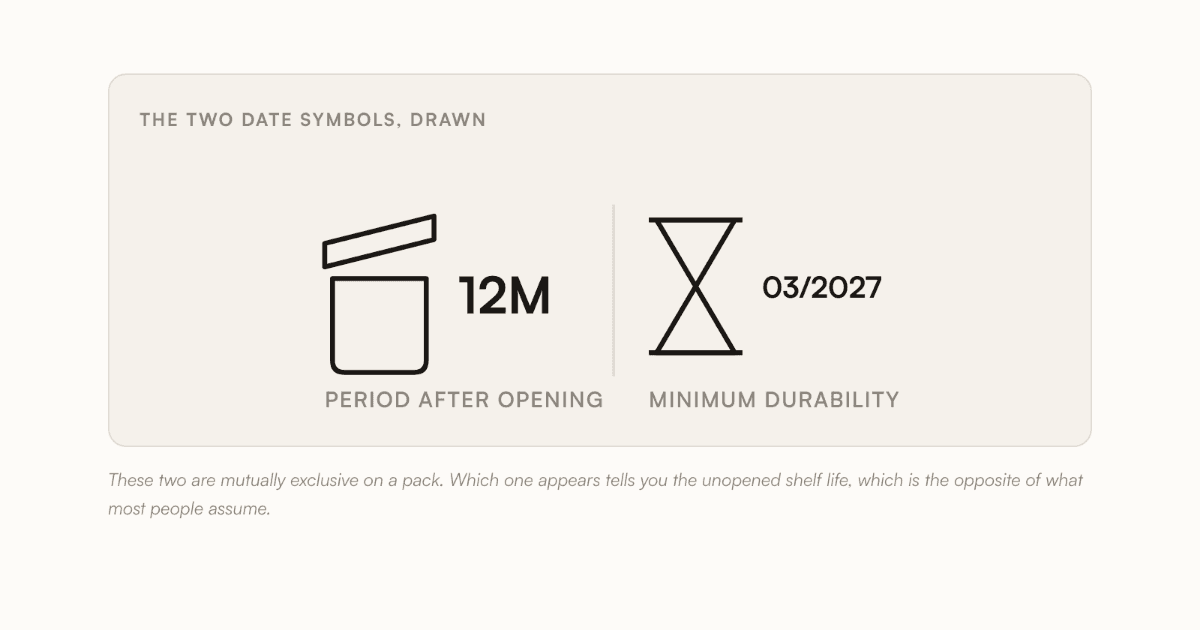
What the Open-Jar Symbol on Your Makeup Actually Means
The little jar with '12M' on it tells you more than you think — and its absence tells you something too. What the law actually requires, in the EU and the US.
August 6, 2026
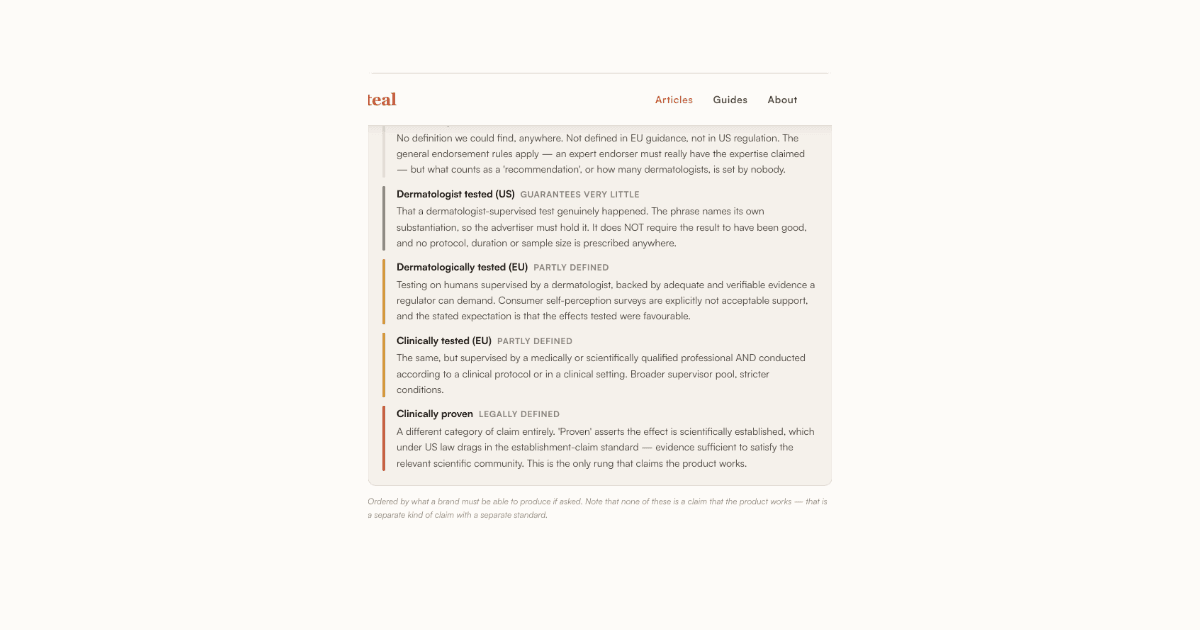
What 'Dermatologist Tested' Means on a Label
It is a claim about process, not result — and a European court ruled on exactly this phrase in 2002. What it obliges a brand to hold differs completely between the EU and the US.
August 4, 2026
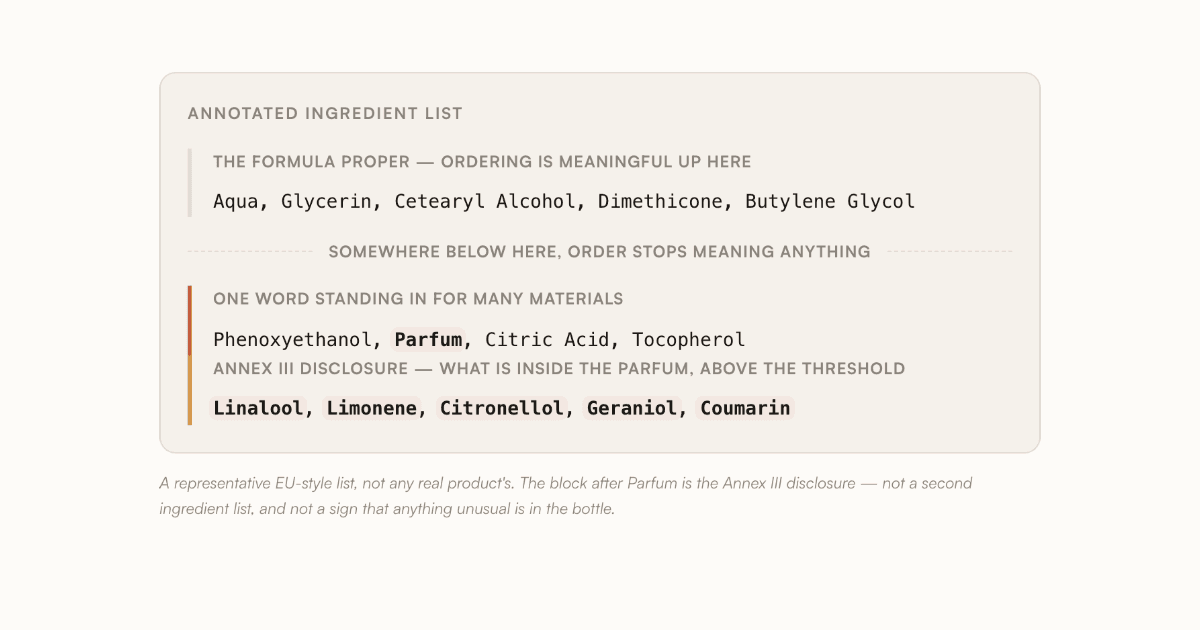
How to Spot Fragrance on an Ingredient List
The word to look for is 'Parfum' in the EU and 'Fragrance' in the US — and the chemical names sitting after it are not a separate ingredient list. Also: the '26 EU allergens' figure everyone quotes has been wrong since 2022.
August 3, 2026