How to Spot Fragrance on an Ingredient List
The word to look for is 'Parfum' in the EU and 'Fragrance' in the US — and the chemical names sitting after it are not a separate ingredient list. Also: the '26 EU allergens' figure everyone quotes has been wrong since 2022.
GlowSteal Editor
Fragrance hides behind a single word. On a European label it is Parfum — or Aroma if it is there for taste rather than smell. On a US label it is Fragrance or Flavor. One word can stand in for dozens of individual materials, and that is entirely legal in both markets.
The second thing to know is that the chemical-sounding names you often see immediately after Parfum — Linalool, Limonene, Citronellol, Geraniol, Coumarin — are not a separate ingredient list. They are a disclosure of what is inside the parfum, required because those specific substances are known contact allergens.
Both of those facts are about to matter more than usual, because the EU list changes this week.
Commission Regulation (EU) 2023/1545 roughly quadruples the number of fragrance substances that must be individually named on an EU label. Its first deadline falls on 31 July 2026.
The regulation was adopted in July 2023 with a three-year runway. If you are reading this in the days around that date, labels are mid-change — which is exactly why the next section matters.
The number everyone quotes is wrong, and has been since 2022
Search for this topic and you will be told the EU requires 26 fragrance allergens to be individually named. That figure is out of date, and the regulation that expanded the list says so in its own recitals:
"Currently, 24 fragrance allergens listed in entries 45 and 67 to 92 of Annex III to Regulation (EC) No 1223/2009 are to be mentioned in the list of ingredients (individually labelled)."
Twenty-four, not twenty-six. The list lost two members — not by being downgraded, but by being banned outright, which is a stronger outcome than labelling:
- Regulation (EU) 2017/1410 prohibited HICC (sold as Lyral) and deleted its Annex III entry. The regulation is explicit about the mechanism: "Since HICC should be prohibited in cosmetic products, it is necessary to delete that entry."
- Regulation (EU) 2021/1902 added a further fragrance substance to Annex II as a CMR and deleted two more Annex III entries.
So when a source says "the EU's 26 allergens", it is describing a list that stopped being accurate several years ago, and two of the substances it names are not allergens you should check for — they are substances that are no longer permitted at all.
This is not internet sloppiness. It is upstream.
The European Commission's own topic page on fragrance allergens labelling, fetched on 28 July 2026, still reads: "At the moment, 26 fragrance allergens are subject to individual labelling (annex III of the cosmetics regulation)." It still describes the expansion as something "the Commission services are discussing," and it does not mention Regulation (EU) 2023/1545 anywhere — three years after that regulation was adopted, and three days before its first compliance deadline.
The FDA's Allergens in Cosmetics page reproduces the same outdated list of 26, and describes them as being in "Annex III of the European Union Cosmetics Directive" — 1223/2009 is a Regulation, and the Directive it replaced was repealed in 2013.
Two regulators, both citing a superseded list. If you have read the wrong number, this is very likely where it came from.
What actually changes
The Scientific Committee on Consumer Safety reviewed the list and, per recital 6 of the 2023 regulation, "identified 56 additional fragrance allergens, which have clearly caused allergies in humans and which have currently no requirement of individual labelling."
Those get the same treatment at the same trigger points: naming required above 0.001% in leave-on and 0.01% in rinse-off products. Those thresholds are a factor of ten apart, they are identical across every allergen entry, and they have not changed.
The same recital extends the rules to substances that are not allergens when you buy them — "prehaptens and prohaptens, that can be transformed to known contact allergens via air oxidation or bioactivation". The EU is regulating what a fragrance ingredient turns into as the bottle ages; one new entry even caps the substance's peroxide value.
The 45 new Annex III entries are not a list of synthetics. They sweep in jasmine, rose, eucalyptus, lemongrass, ylang-ylang, neroli, narcissus, clove and Peru balsam, among others — as oils and as extracts.
If your reason for avoiding fragrance is sensitivity rather than preference, the "essential oils are gentler" framing is precisely what this regulation moved against.
Two dates, and why the gap matters to you
A trap worth knowing if you go looking at the regulation yourself: Article 2 contains no transition dates. It says only that the regulation enters into force twenty days after publication. Read the Articles and stop, and you would conclude there is no transition period at all. The deadlines are in footnotes to the Annex table — non-compliant products "may be placed on the Union market until 31 July 2026 and made available on the Union market until 31 July 2028."
Those are two different things, and the difference is the part that affects a shopper:
| Date | What it stops |
|---|---|
| 31 July 2026 | Last day a non-compliant product may be placed on the EU market — i.e. supplied by the manufacturer or importer. |
| 31 July 2028 | Last day it may be made available — i.e. sold to you from a shelf. |
So EU shelves can legally carry old-style labels for another two years. If you pick up two jars of the same product in 2027 and their ingredient lists differ in length, neither one is a mistake. Recital 11 explains the design: "the transition period should be 3 and 5 years, respectively."
The US works the opposite way round, grammatically
The two markets look similar and are built on inverted verbs.
EU — mandatory. Article 19(1)(g) of Regulation (EC) No 1223/2009: perfume and aromatic compositions and their raw materials "shall be referred to by the terms 'parfum' or 'aroma'." The word fragrance is not one of the options. If you are looking at a European label, the word is Parfum.
US — permissive. 21 CFR 701.3(a): each ingredient must be declared in descending order of predominance, "except that fragrance or flavor may be listed as fragrance or flavor." A US brand is therefore free to name every fragrance component individually if it wants to. Most don't; FDA's stated rationale for allowing the collective term is trade-secret protection under the Fair Packaging and Labeling Act, not safety.
The same US paragraph contains a limit that is almost never quoted, and it is a useful one:
"No ingredient may be designated as fragrance or flavor unless it is within the meaning of such term as commonly understood by consumers."
The collective term is not an unlimited hiding place. You cannot park an unrelated ingredient under it.
The gap in the usual advice
The standard guidance is "check whether the list says fragrance." In the US that is not sufficient. FDA's own Cosmetics Labeling Guide says an odour-masking agent "may be declared by their individual name(s) or as 'fragrance'" — and at an insignificant level "need not be declared on the label" at all.
So a US product can contain a masking material listed under its own name with the word fragrance nowhere on the pack, or absent entirely.
Show the FDA passage, and the provision it cites
FDA, Cosmetics Labeling Guide:
"The ingredient or mixture of ingredients acting as a masking agent, i.e., covering the undesirable off-odor of a product without adding a discernable odor to it, may be declared by their individual name(s) or as 'fragrance' (in lieu of a better designation). A masking agent present in a product at an insignificant level may be considered an incidental ingredient under § 701.3(1)(2)(iii) in which case it need not be declared on the label."
A tension we could not resolve. That passage cites the incidental-ingredient provision, 21 CFR 701.3(l), which exempts only substances "that have no technical or functional effect in the cosmetic" — and the sub-paragraph it points to concerns processing aids. A masking agent has a functional effect by definition; that is what it is for. We could not reconcile the guide with the regulation it cites, and we are not going to guess which governs.
"Fragrance-free" and "unscented" are not defined, and not opposites
Beauty media draws a tidy distinction: unscented means a masking fragrance was used, fragrance-free means none is present. That distinction has no legal basis in the US.
The FDA states it directly on its allergens page:
"It isn't enough to check for terms like 'hypoallergenic', 'fragrance-free' or 'for sensitive skin,' as there is no federal standard or definition that governs the use of these terms in the U.S."
And on masking specifically:
"Even some products labeled 'unscented' may contain fragrance ingredients. This is because the manufacturer may add just enough fragrance to mask the unpleasant smell of other ingredients, without giving the product a noticeable scent."
The EU has a better rule — the Technical document on cosmetic claims says the claim "free from perfume" should not be used where a product contains an ingredient exerting a perfuming function, "regardless of its other possible functions in the product", which closes the masking loophole neatly. But that document announces in capitals on its own front matter that it "IS NOT A EUROPEAN COMMISSION DOCUMENT" and is not legally binding. It is best practice agreed by a Member State working group, not law.
Does the label track the contents? A 2017 cohort study in JAMA Dermatology examined 174 best-selling moisturisers and found that of those carrying a "fragrance free" claim, 45% contained at least one fragrance cross-reactor or botanical ingredient. That is an audit of labels against ingredient lists in one market sample, not a statement about any particular product — but it is the direct answer to "can I trust the front of the pack".
Putting it together on a real label
Aqua, Glycerin, Cetearyl Alcohol, Dimethicone, Butylene Glycol
Phenoxyethanol, Parfum, Citric Acid, Tocopherol
Linalool, Limonene, Citronellol, Geraniol, Coumarin
What that tail of names does and does not tell you:
- Each one is present above 0.001% (leave-on) or 0.01% (rinse-off). That is the whole of the information.
- It is not a quantity. A named allergen could be at 0.0011% or at 2%. The disclosure is a threshold, not a measurement.
- Their absence does not mean "no fragrance". It means nothing crossed the threshold.
Parfumwith no tail is still fragrance. - A longer tail is not a worse product. It often means the perfume is built from materials the regulation happens to name. An unlisted fragrance is not thereby safer — it is unexamined.
- On a US label none of this appears, because there is no equivalent requirement. Same formula, shorter list.
If you are avoiding fragrance because of a diagnosed contact allergy, the substance names in that tail are the ones worth learning — they are the specific things patch testing identifies. If you are avoiding fragrance as a general precaution, the single word Parfum or Fragrance is the one to look for, and the tail is not extra risk.
What we could not establish
- Which INCI name held the deleted Annex III entries. We can show that Regulation (EU) 2021/1902 banned a specific CAS number and deleted two Annex III entries. Mapping those entry numbers back to the ingredient names people know them by needs the CosIng database, which serves only an empty application shell to anything but a real browser. We have not asserted the mapping.
- The post-expansion total. You will see "around 80 allergens". No regulation we read states a total; it is 24 plus 56, done by hand. Worse, the number of substances is not the number of names you will see — several Annex III entries group multiple substances under one mandated label name, so several chemicals can arrive on your label as a single word.
- The UK position. The UK's assimilated version of Regulation 1223/2009 still shows the pre-2023 allergen set. Whether the UK has adopted an equivalent expansion, and on what timetable, we could not determine from primary sources. Treat everything above as EU and US only.
- Whether the US will follow. FDA's MoCRA page lists "fragrance allergen labeling requirements" among the regulations the Act requires it to establish. Unlike the talc and manufacturing-practice items on the same page, no proposed or final rule is linked. We did not locate one — which is not the same as establishing that none exists.
- The SCCS's reasoning. We read the two regulations that cite opinion SCCS/1459/11; we did not read the opinion itself. Nothing here characterises how the committee reached its conclusions.
Sources consulted, retrieved 28 July 2026:
- Commission Regulation (EU) 2023/1545 — amending Regulation (EC) No 1223/2009 as regards labelling of fragrance allergens. Quoted for the count of 24, the 56 additions, the thresholds, prehaptens/prohaptens, and the Annex footnote transition dates.
- Commission Regulation (EU) 2017/1410 — quoted for the prohibition of HICC and the deletion of its Annex III entry.
- Regulation (EC) No 1223/2009, Article 19 — quoted for the mandatory 'parfum'/'aroma' wording and the Annex III add-on obligation.
- Fragrance allergens labelling — European Commission, DG GROW. Cited as evidence that the Commission's own consumer-facing page is out of date, not as authority for the count.
- 21 CFR 701.3 — designation of ingredients, via the eCFR versioner API. Quoted for the permissive collective term and the "commonly understood by consumers" limit.
- Cosmetics Labeling Guide, Fragrances in Cosmetics and Allergens in Cosmetics — US Food and Drug Administration.
- Xu S, Kwa M, Lohman ME, et al. Consumer Preferences, Product Characteristics, and Potentially Allergenic Ingredients in Best-selling Moisturizers. JAMA Dermatol 2017;153(11):1099–1105.
- Technical document on cosmetic claims (Sub-Working Group on Claims, version of 3 July 2017), hosted on ec.europa.eu. Quoted for the "free from perfume" position and for its own statement that it is not legally binding.
Regulation changes, and this article describes it as we read it on the date above. It is general information rather than legal or medical advice — a suspected contact allergy is worth taking to a dermatologist for patch testing, which identifies the specific substance in a way a label cannot. GlowSteal has not tested any product for this article.
Enjoyed this post?
Get more like it delivered every Tuesday.
You might also like
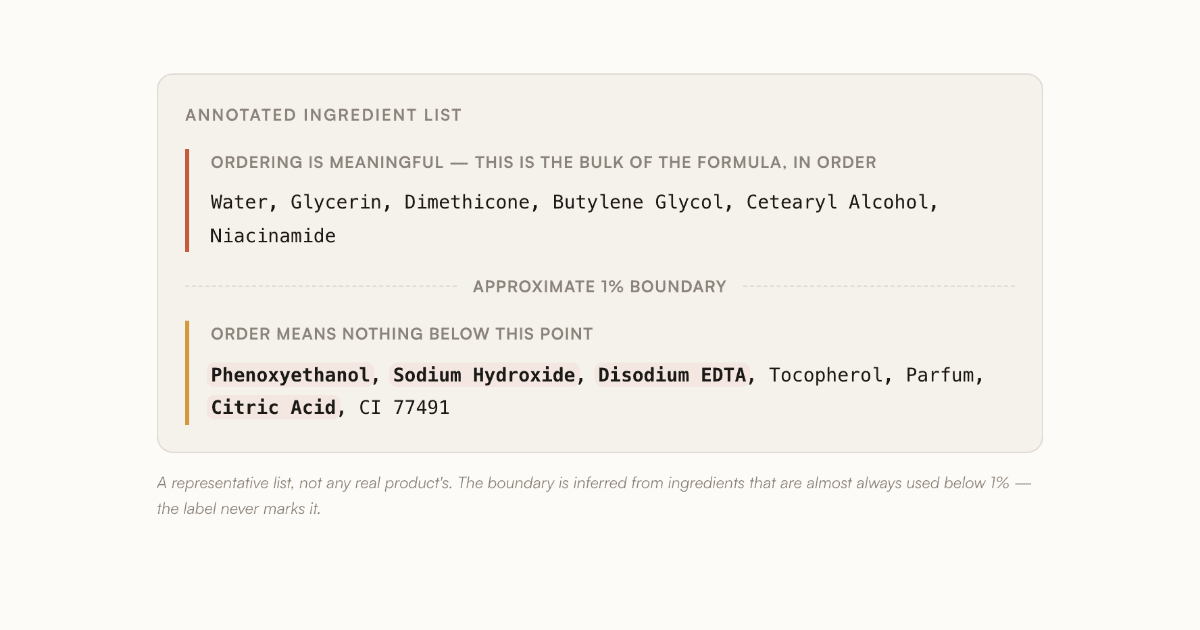
How to Read a Cosmetic Ingredient List
Ingredient lists are ordered by weight — until they aren't. The 1% rule is the single most useful thing to understand, and it's the thing most often explained wrongly.
July 31, 2026
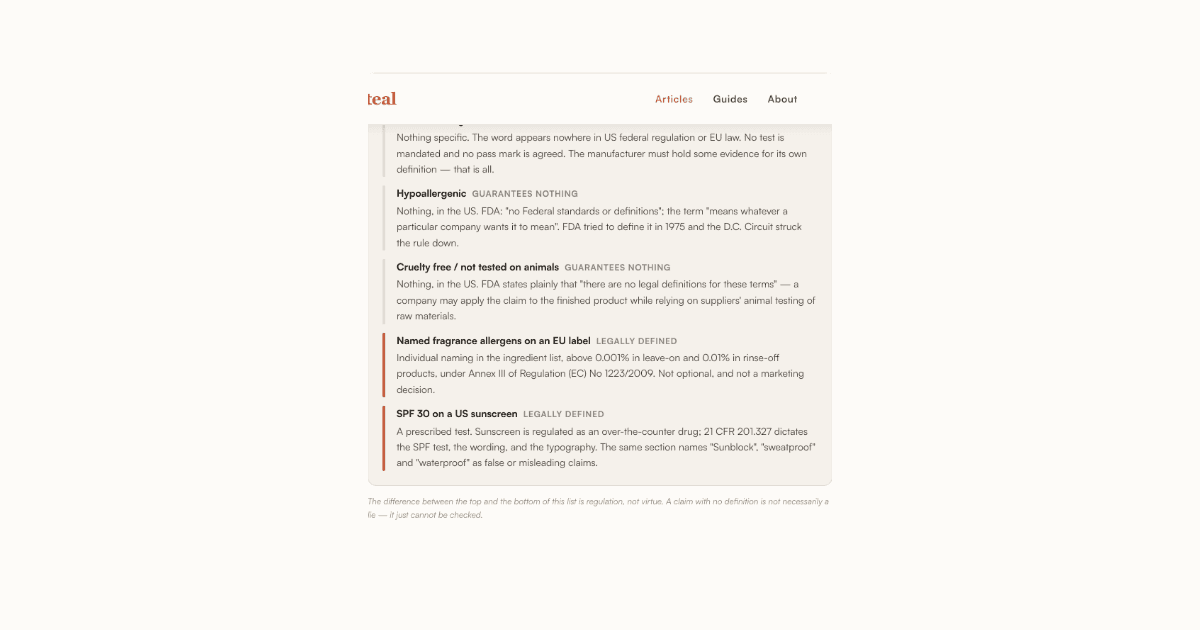
What 'Non-Comedogenic' Actually Guarantees
The word does not appear anywhere in US federal regulation, or in EU law. No test is required and there is no pass mark. Here is what the label is really telling you — and why dermatologists still say to look for it.
August 5, 2026
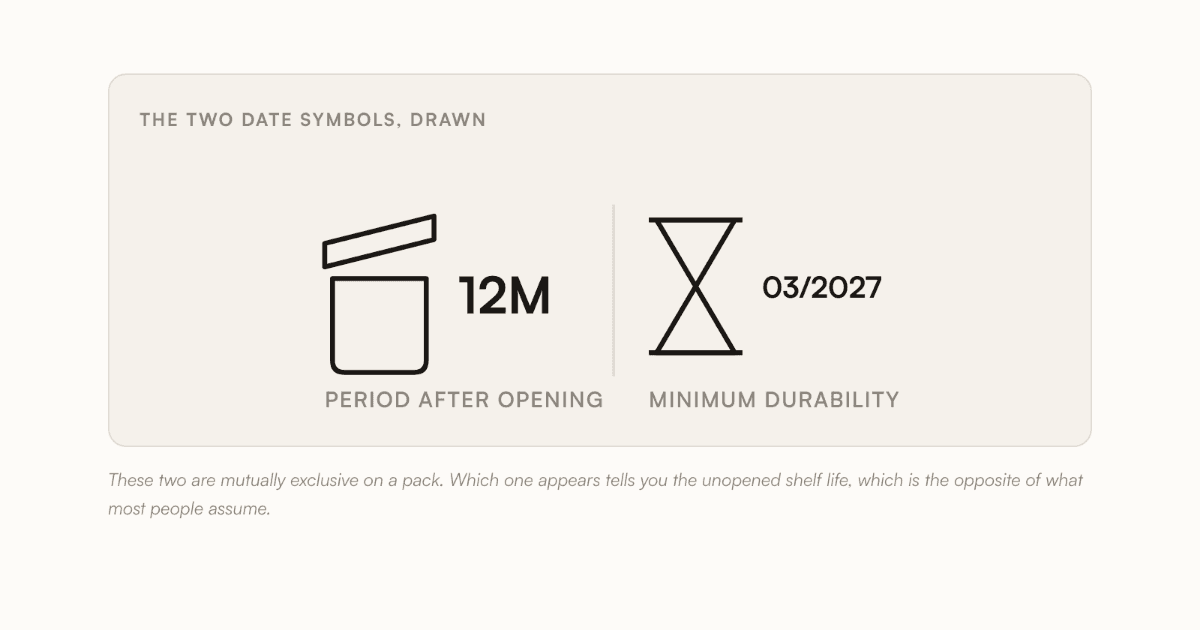
What the Open-Jar Symbol on Your Makeup Actually Means
The little jar with '12M' on it tells you more than you think — and its absence tells you something too. What the law actually requires, in the EU and the US.
August 6, 2026