Why Concealer Creases Under Your Eyes
Concealer looks smooth going on and collects in fine lines an hour later. Here's what's actually happening — separating what the research supports from what's just convention.
GlowSteal Editor
Concealer creases under your eyes for one main reason: there is more product sitting there than that skin can hold still. The under-eye area is the thinnest skin on your face, and it moves constantly — every blink, every smile. Product has to go somewhere, and it goes into the lines.
Almost everything that genuinely helps comes back to using less. The rest of the advice you'll read is a mix of reasonable convention and confident guessing, and this article tries hard to tell you which is which.
First, diagnose it
When your concealer creases tells you what to change. Run this before changing products.
- Within ~10 minutesToo much product, or the layer underneath hasn't set.Apply roughly half as much. Wait longer after moisturiser or eye cream before you start.
- Only when you smileNormal movement, not a product failure.Expression folds the skin and anything on top follows. Less product reduces how visible it is. Nothing eliminates it.
- Gradually, over a few hoursSebum is migrating into the product and thinning it.This is the one branch where a light setting powder has a mechanism behind it.
- It looks dry or patchy rather than creasedA different problem.The base is clinging to dehydrated texture rather than moving across it. Address hydration, not longevity.
Most people who think they have a "product problem" are in the first two branches, where the fix is technique and expectation rather than a different concealer.
Why this area specifically
Eyelid skin is the thinnest on the body. That much is well established, though the exact numbers depend on precisely where you measure.
One study of upper eyelid skin thickness found the thinnest point near the lash margin at roughly 320 micrometres, rising to about 1,127 micrometres just below the eyebrow — more than a threefold difference across a single eyelid. A broader survey of facial skin thickness likewise found the least total thickness at the upper medial eyelid.
You'll see "the skin under your eyes is 0.3mm thick" repeated constantly. It traces back to measurements at the lash margin specifically — the single thinnest point — not the whole under-eye area you actually apply concealer to. The area under your eye is thicker than that, and it varies by person, age and exact location. The general point stands; the precise number is usually being misapplied.
Thin skin matters here for a mechanical reason rather than a mysterious one. A thin, mobile surface folds more readily under the same movement, and anything sitting on top folds with it. Add that this skin flexes with every blink, and you have a surface that is close to the worst case for holding a cosmetic film still.
A lot of beauty writing states that the under-eye area has few or no oil glands, and concludes that concealer therefore has "nothing to grip". While researching this piece we found sources on both sides — some describing the periorbital area as having notably few sebaceous glands, others describing the periocular region as sebaceous-gland rich in the context of Malassezia growth.
We are not able to resolve that from the sources we could access, so we're not going to build an explanation on top of it. Treat any confident claim about under-eye oil gland density — including ones you'll read elsewhere — with some scepticism.
What actually reduces creasing
Use less product
This is the single highest-impact change, and it is not a satisfying one.
Concealer creases in proportion to how much of it is there. A thin layer has less material to gather into a fold. The instinct when coverage looks insufficient is to add another layer, which makes creasing worse rather than better — and heavier coverage over a fold reads as more obvious, not less.
Apply roughly half what you think you need, then stop and look after two or three minutes. Most under-eye darkness needs far less product than it appears to at the moment of application, when you are looking at bare skin.
Let the layer underneath finish
If you apply eye cream or moisturiser and go straight into concealer, you are placing product onto a surface that is still wet and still moving. It will slide.
We could not find a well-sourced number for how long to wait, and we're not going to invent one — the honest answer is "until the skin no longer feels damp", which depends on the product, the amount and the room. If you currently wait no time at all, waiting a few minutes is the change worth testing.
Set it lightly, if — and only if — it breaks up over hours
Setting powder has a real mechanism behind it, but a narrower one than it's usually credited with.
Cosmetic formulation literature describes makeup breaking down over a wear period as sebum migrates into the product and over-wets the powder phase, changing how it sits and reflects light. Formulators address this with powders chosen for oil absorption, and with powders having low surface energy that resist taking on sebum in the first place — a patent covering exactly this combination describes using both together specifically so that sebum excreted over time does not modify the cosmetic's properties.
That mechanism explains the gradual break-up over hours branch of the diagnostic. It does not explain creasing that appears within ten minutes, which is a quantity-and-movement problem that powder cannot fix — and may worsen, by adding yet more material.
Leaving a thick layer of powder to sit before dusting it away is a widely repeated technique, and it is genuinely not for everyone. On drier or more mature skin, a heavy powder layer tends to emphasise texture rather than smooth it. If your creasing is the immediate kind, baking adds product to a problem caused by product. Treat it as one option among several, not a default step.
What to stop expecting
Some under-eye movement is not a problem to be solved.
If your concealer looks smooth at rest and gathers slightly when you smile, that is skin doing what skin does. Expression folds it; anything on top follows. Using less product reduces how visible that is. Nothing removes it, and no product claim should convince you otherwise.
The genuinely useful shift is from "which concealer won't crease" to "how little can I get away with" — the first question has no good answer, and the second one usually does.
What we could not establish
In the interest of not overstating things:
- Whether formula type predicts creasing more than quantity does. It's plausible that thicker, higher-coverage formulas crease more simply because more material is present, but we found no sourcing that isolates formula from amount.
- Whether eye cream applied immediately before makeup measurably increases movement, as opposed to it being an application-timing issue generally.
- Under-eye sebaceous gland density, as described above.
Where we've relied on reasoning rather than a source, we've tried to say so in the text rather than let it read as established.
Sources consulted, retrieved 28 July 2026:
- Thickness of Korean upper eyelid skin at different levels — PubMed
- A comprehensive examination of topographic thickness of skin in the human face — PubMed
- Ultrasonographic analysis of facial skin thickness in relation to age, site, sex, and body mass index — PMC. Note: this study did not measure the eyelid region directly, and studied a Korean population with Fitzpatrick skin types III–IV only.
- EP1473018B1 — Cosmetic composition comprising a powder capable of absorbing sebum and a powder with a low critical surface energy — European Patent Office. A patent is a technical document but also an advocacy document for its own invention; used here for formulation mechanism, not efficacy.
GlowSteal has not tested any product for this article. This is general information, not medical advice — if the skin around your eyes is irritated, flaking or reacting, see a qualified healthcare professional rather than changing your makeup.
Enjoyed this post?
Get more like it delivered every Tuesday.
You might also like
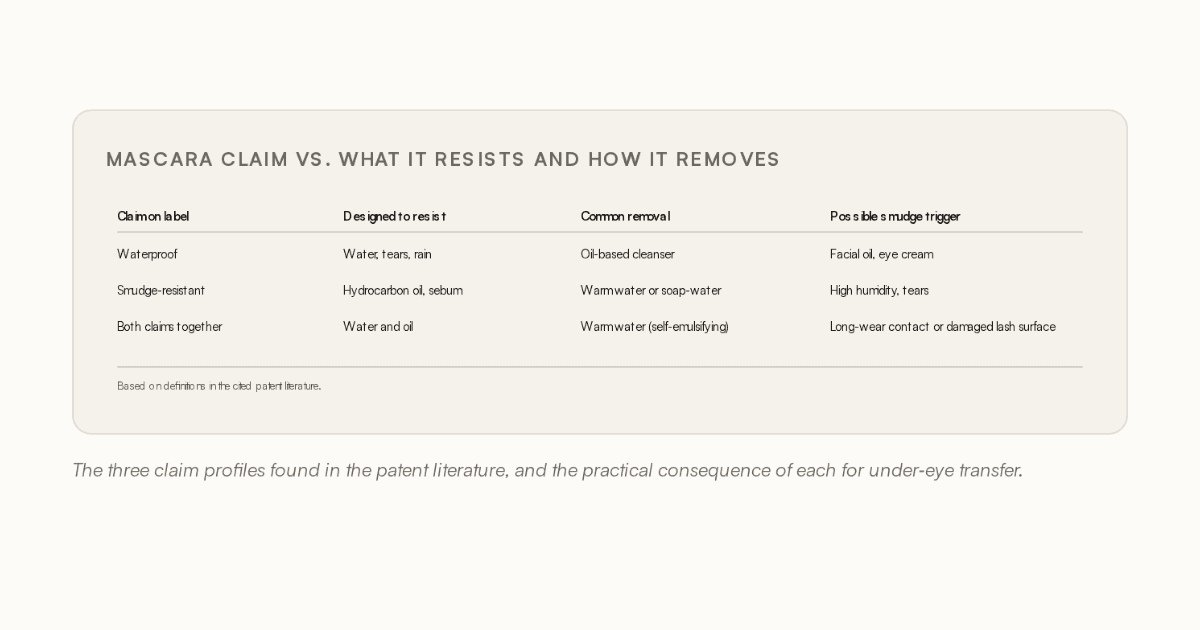
Why your mascara smudges under your eyes — and what the formula type has to do with it
Smudging happens when moisture meets a water‑attracting film, skin oils dissolve the binder, or curled lashes touch the lower lid too often. The formula’s resistance claims point to which of these is at play.
August 10, 2026
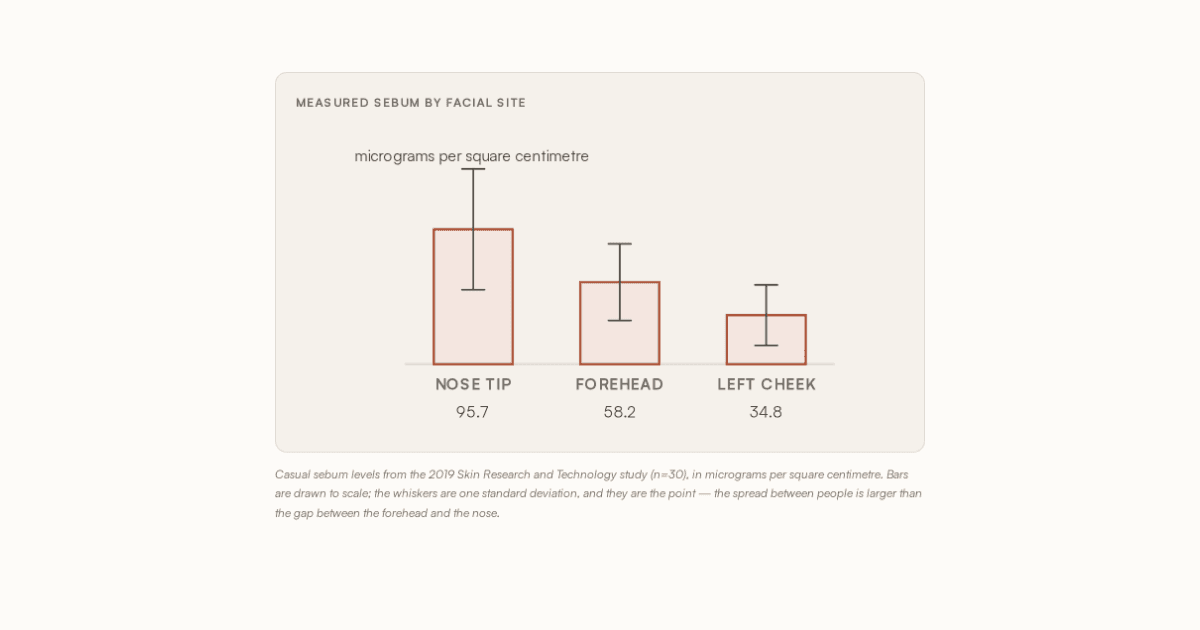
Why Foundation Separates Around Your Nose
The nose is measurably the oiliest part of the face — around three times the cheek in one study. That much is established. The explanation everyone gives for why makeup breaks up there is not.
August 8, 2026
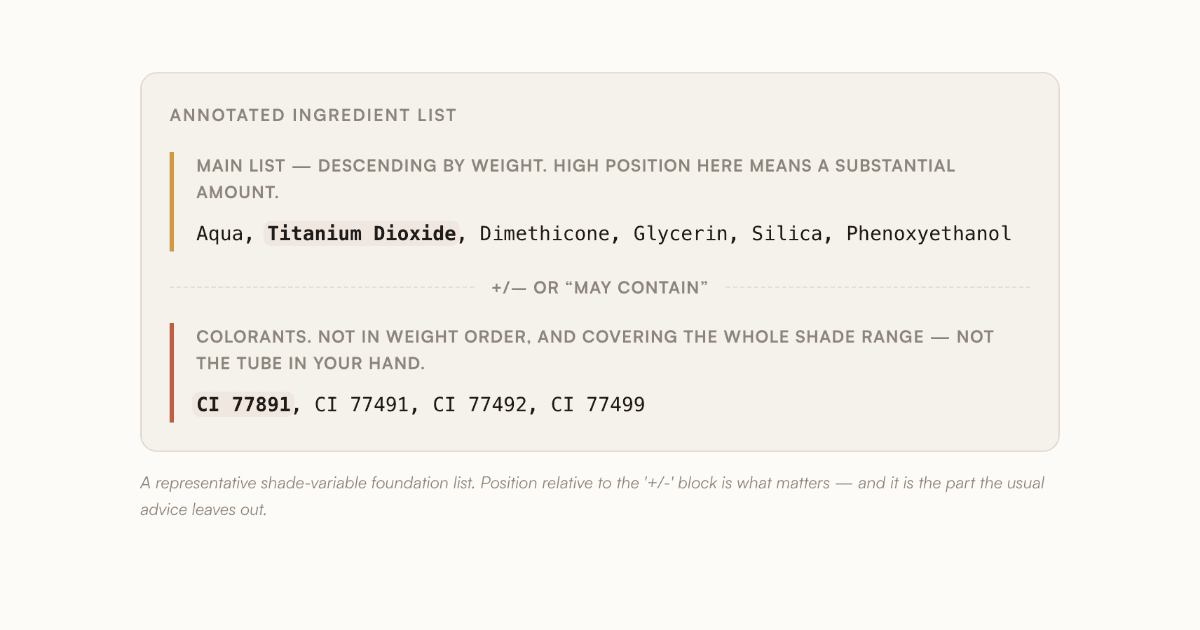
Why Your Face Looks White in Flash Photos
The flash doesn't cause it. The white cast is there in ordinary light too — the flash just makes it obvious. And the usual advice, including avoiding 'nano' and dropping SPF, points the wrong way.
August 5, 2026