Tubing Mascara vs Traditional Mascara
Three things everyone says about tubing mascara are wrong: that you can spot one from the ingredient list, that they're wax-free, and that warm water alone removes them. The patents say otherwise.
GlowSteal Editor
A tubing mascara forms a continuous polymer film around each lash as it dries, rather than depositing wax and pigment onto it. That film is engineered to resist cold water and release in warm water — which is why it comes away in soft tubular pieces instead of smudging.
That much holds up. Three things that are repeated everywhere alongside it do not, and we went to the patent literature to check.
You cannot identify one from the ingredient list
This is the claim worth demolishing first, because it is the advice people actually try to act on.
The standard version is: look for acrylates copolymer, or a polyurethane, or a list with no waxes, and you have found a tubing mascara. It fails for three independent reasons.
1. The patented effect is a ratio, not an ingredient. The most recent granted patent for a tubing mascara composition attributes the property not to any particular polymer but to a concentration floor — at least 9% by weight of film-forming aliphatic polyurethane resin — and to a ratio of total polyurethane resin to total wax, held between roughly 0.78 and 0.92 in the granted claim.
Neither a percentage nor a ratio can be recovered from an ingredient list. Lists give descending order only, and below 1% they give no order at all. The entire genre of "check the ingredients to spot a tubing mascara" is structurally impossible, not merely unreliable.
2. The same polymers appear in explicitly non-tubing mascaras. One L'Oréal patent describes a wax-free mascara built on dispersed acrylic film-forming polymer particles — and presents it as water-resistant and long-wearing for more than a day, which is close to the opposite of a warm-water-removable tube. Another wax-free filing uses PVP with an acrylic film former and never uses the words tube, tubular or tubing at all.
A wax-free list full of acrylates copolymer is at least as likely to be a long-wear mascara as a tubing one.
3. And the premise is backwards anyway — see the next section.
This is the single most repeated claim about the category and the patent contradicts it outright.
The granted claim for the tubing composition requires "one or more waxes". Its description specifies a total wax concentration of at least 14–15% by weight, and the granted claim also constrains what proportion of that wax is paraffin.
So "no wax in the ingredient list" points away from this patented tubing route, not toward it.
Warm water alone does not remove it
Every primary source that describes a removal procedure specifies mechanical action, and water considerably warmer than lukewarm.
- The tubing patent describes applying warm water to the lashes several times over two minutes, followed by either wiping with gentle pressure using a cotton pad or physically pulling the film off with fingertips.
- An earlier L'Oréal patent specifies water at or above 35 °C, in the range 35–50 °C, plus rubbing with cotton wool or gauze — describing the film as being "made brittle on contact with warm water" so that rubbing disintegrates it.
- Another L'Oréal filing puts the water at about 50 °C or higher, and concedes that conventional soap or make-up remover may also be used.
The accurate version is: warm-to-hot water, plus sustained contact time, plus deliberate mechanical action. "Just splash warm water on it" is not what any primary source describes.
There are two different mechanisms, not one
Articles that give you a single confident explanation of how tubing works are picking one and hiding the other.
Route A — concentration and ratio. The recent tubing patent attributes the effect to how much polyurethane resin is present relative to wax. It offers no molecular explanation for why warm water releases the film. It simply asserts the property follows from the ratio.
Route B — a thermal phase change. An earlier L'Oréal patent combines a hydrophobic film former with a semi-crystalline polymer melting between 30 and 80 °C. Here the mechanism is explicit: above its melting point the semi-crystalline polymer changes state and makes the film water-sensitive, so it becomes brittle and disintegrates when rubbed.
These are not two descriptions of the same thing. They are different routes to a similar consumer-facing result, and the two patents even disagree about how the film leaves the lash — one describes intact tubular clumps sliding off, the other describes a film crumbling under rubbing.
Patents are the only detailed public description of these formulations, so they are the right source for mechanism and for what the industry calls things.
But a patent is also an advocacy document for its own invention. Nothing here says a tubing mascara performs better, lasts longer, or is gentler than any alternative. None of that is established by anything we read.
How the three film types actually differ
Underneath the marketing categories there is a real formulation taxonomy, and it is about what the film is dispersed in:
| Type | What it is | Why it comes off the way it does |
|---|---|---|
| Conventional | Waxes and pigments dispersed in water. | Water evaporates and leaves the deposit behind. That deposit re-softens on contact with water, sweat and sebum — which is what smudging is. |
| Waterproof | Waxes dispersed in a volatile hydrocarbon, with very little water — one patent defines anhydrous as under 5%, better under 2%. | The solvent flashes off leaving a continuous hydrophobic wax film that water cannot re-wet. Hence oil or solvent removers. |
| Tubing | A continuous polymer film, not a wax deposit. | Engineered to fail cohesively — to release as a piece — rather than to dissolve. |
The clean binary everyone uses does not survive the patent record. There is a granted Coty patent titled Water-resistant mascara composition having a high water content which states:
"the mascara according to the invention is water-proof, but can be washed off completely with warm water at a temperature of approximately 29° C. and above."
It holds 42–75% water and is never described as tubing. So warm-water removability does not uniquely identify a tubing formula.
One safety counterweight worth knowing
Tubing mascara is often recommended on the grounds that removing it needs no rubbing. The evidence on removal and lash loss does not support treating "comes off with water" as automatically gentler.
A 2013 study in the Journal of Cutaneous and Aesthetic Surgery surveyed medical students on eye-cosmetic use and eyelash loss. Among its findings:
"a higher incidence of fall was associated with the use of water in subjects who used water proof mascara [27% vs. 13%]"
The authors attribute it to technique rather than to water itself: "Vigorous rubbing using fingers during removal with water can cause loss of eyelashes."
That is an observational survey with author-acknowledged recall limitations, and it is about waterproof mascara rather than tubing formulas specifically. It is suggestive, not causal. But since every primary description of tubing removal also specifies rubbing or pulling, "it removes with just water" should not be read as "it removes without force."
What we could not establish
- Which mechanism commercial tubing mascaras actually use. We found two incompatible routes in the patent literature and no way to tell which, if either, is in any product on a shelf.
- Where the category came from. The widely repeated origin story crediting a specific Japanese brand is unverified — searches returned only retailer marketing copy, which is not evidence. Meanwhile warm-water-removable mascara appears in patent filings from 2001 onward, well before the consumer term was popularised. We are not asserting an origin.
- Any INCI-list test that works. We found no primary source establishing one, and the ratio-and-threshold structure of the patented composition suggests none can exist. Seeing a specific polyurethane named in a tubing patent is consistent with a tubing formula; it is not an identification test.
- How any of these perform. We read patents and one observational survey. Nothing here compares products, and GlowSteal owns none.
- Whether the INCI names in these patents are current. CosIng, the EU ingredient database, serves an empty application shell to anything but a browser, so no ingredient name here has been checked against it.
Sources consulted, retrieved 28 July 2026:
- US12472138B2 (Boots Co PLC) and its application AU2019422399A1 — tubing mascara composition, the polymer-to-wax ratio, the wax requirement and the removal procedure.
- US7358303B2 (L'Oréal) — the semi-crystalline polymer route and the 35–50 °C removal.
- US7682605B2 (Coty) — waterproof and warm-water washable at 42–75% water content.
- EP1249225A1 and US9474710B2 (L'Oréal) — wax-free, non-tubing mascaras using the same polymer families.
- WO2016110544A1 (L'Oréal) — the conventional/waterproof formulation taxonomy and the anhydrous definition.
- Kadri R, Achar A, Tantry TP, et al. Mascara induced milphosis, an etiological evaluation. J Cutan Aesthet Surg 2013.
Every patent here argues for its own invention and is used only for how the chemistry is described, never as evidence that anything works or performs better. GlowSteal has not tested any product for this article. General information, not medical advice — if your lashes are falling out, that is worth a doctor rather than a mascara change.
Enjoyed this post?
Get more like it delivered every Tuesday.
You might also like
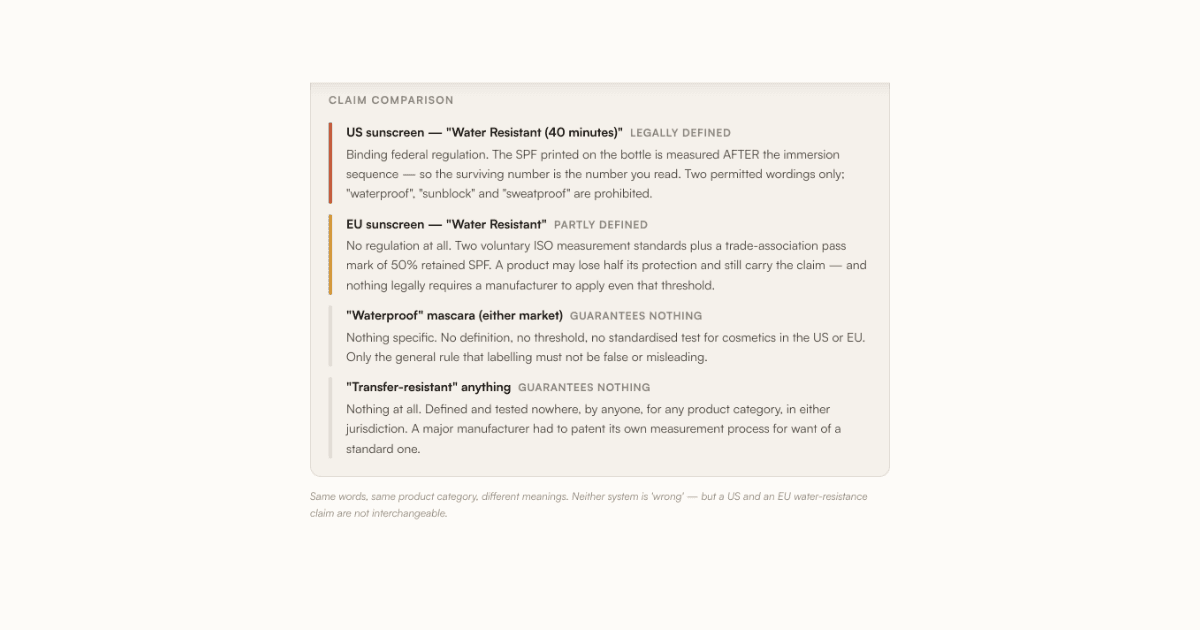
Transfer-Resistant vs Water-Resistant vs Waterproof
One of these three words is regulated, and only on sunscreen — which the US doesn't classify as a cosmetic at all. On mascara and foundation, all three mean whatever the brand decided.
August 1, 2026
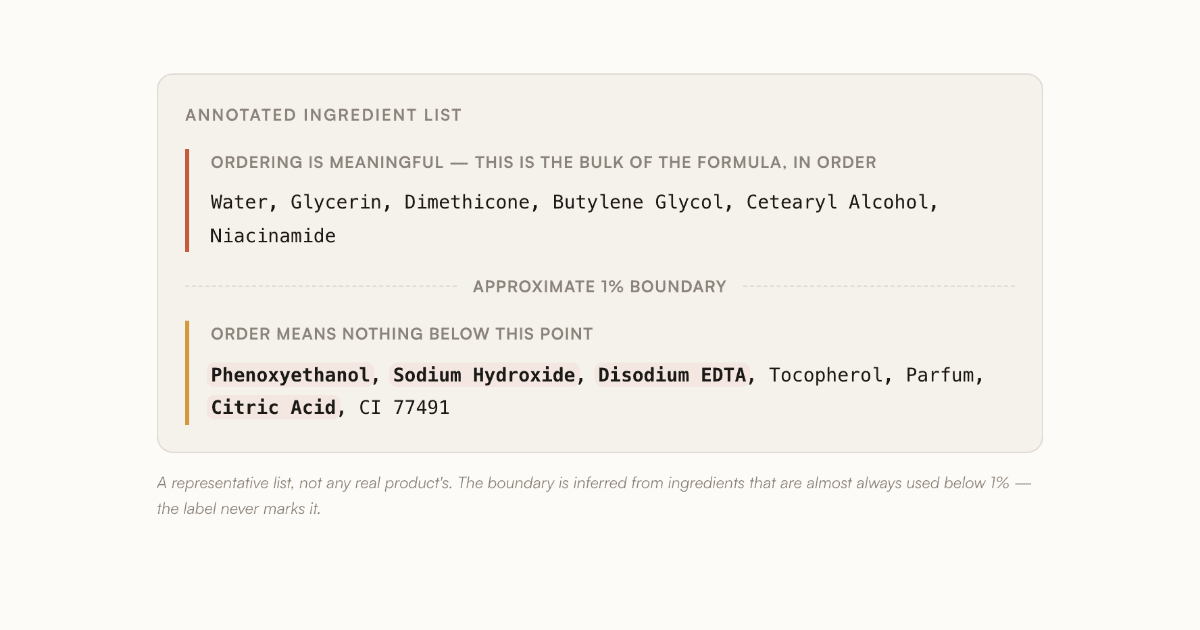
How to Read a Cosmetic Ingredient List
Ingredient lists are ordered by weight — until they aren't. The 1% rule is the single most useful thing to understand, and it's the thing most often explained wrongly.
July 31, 2026